

The clean energy transition has a hardware problem
Share
.svg)

.svg)
.svg)
About the episode
The electric grid is under pressure from every direction: surging demand from AI data centers, electrification, utility-scale renewables, and new industrial loads. But according to Drew Baglino, one of the biggest constraints isn’t generation, it’s the aging hardware that moves electricity across the system.
In this episode, Alfred Johnson sits down with Drew Baglino, founder and CEO of Heron Power and former Tesla executive, to discuss why power electronics have become critical bottlenecks in the clean energy transition. After nearly two decades at Tesla leading powertrain, charging, and energy systems, Drew is now focused on rethinking the electrical infrastructure underlying the modern grid.
Together, they dig into the explosive growth in electricity demand, the supply chain constraints facing medium-voltage transformers, and Heron Power’s effort to replace traditional transformer systems with software-enabled solid-state power electronics. Baglino explains how modular, semiconductor-based systems could make grids more reliable, easier to service, safer, and dramatically faster to deploy.
Critical Capital is a co-production of Crux and Latitude Studios. Learn more about how Crux is financing the future of energy.
Episode transcript
Drew Baglino: To have a sustainable energy economy, which is largely going to be an electric-powered one, we need to triple, or maybe even quintuple, the electricity generation and consumption on the planet.
And, while it's clear that renewable energy developers are great at developing a ton of solar and batteries and we can produce millions of electric vehicles per year, it is not obvious that the electricity sector itself can grow by 500%.
Alfred Johnson: The US electric grid has been called the world's largest machine, but it's a machine built for a different era. It was designed a century ago for a system with predictable demand, centralized generation, and a lot less overall electricity consumption. Today, that system is being asked to do something completely different. Demand is rising fast from data centers, electrification, and manufacturing, and the physical backbone of the grid — the switches, fuses, cables, and transformers — are straining to keep up. And this bottleneck exists no matter where power comes from — solar, batteries, gas, or nuclear — because the limiting factor often isn't the generation, it's the hardware that actually delivers the electricity. Enter solid-state transformers.
Drew Baglino: So when thinking about the products that we're working on, it's gotta be with that objective in mind — we're trying to have like a measurable impact on that, and so we should be solving the biggest problems and trying to unblock that acceleration as much as possible.
Alfred Johnson: This is Critical Capital. Welcome. I'm Alfred Johnson, the CEO of Crux, the capital platform for the clean economy. And today we're looking at the intersection of energy, markets, and policy from the ground-level perspective of the grid. My guest is Drew Baglino. He spent his career, in one form or another, working on how power is distributed and how to make electrical systems more efficient. He spent nearly two decades at Tesla, where he was the powertrain architect for the Model S and later led Tesla's global charging and energy business. In 2024, he founded Heron Power, a company building power electronics designed for a very different kind of grid. A grid where the constraint isn't just generation, but the hardware needed to move electricity, and where speed, flexibility, and reliability are becoming even more critical.
We talked about the growing bottleneck in grid equipment, why transformers and power electronics are suddenly in such short supply, and what it would take to scale the system fast enough to meet rising demand.
Drew. Welcome to Critical Capital.
Drew Baglino: Thanks Alfred. Happy to be here.
Alfred Johnson: So I have to disclose the last time we were together, I dislocated my shoulder, so I'm trying to get out of this conversation a little bit better situated than the last time.
Drew Baglino: Yeah, we all got too excited that day on the slopes, I guess.
Alfred Johnson: So Drew, you spent 18 years at Tesla. You worked from an engineer, leading powertrain and energy, and then you worked on things like the Powerwall and the Megapack, helped scale Tesla's global energy business. And then you left Tesla and started Heron. We're gonna get into all of that.
You said that when you left Tesla, you went on a fact-finding mission and everybody kept saying the same thing to you: power electronics. Why are they so important?
Drew Baglino: Lots of answers to that question. Yeah, I got invited to a whole bunch of VC events after I left Tesla, which was kind of fun. I had never really done that before. And I started meeting entrepreneurs working in energy and climate, so folks working on carbon sequestration, folks working on clean hydrogen production, on next-generation solar stuff, on long-duration batteries, on fusion, electric steel production. And really everybody was like, "I think I've got my main process dialed, but I can't find any power electronic solutions. Do you know any good ones? I know that you worked on those at Tesla."
And I was like, "Interesting. There's a theme coming up here." And part of it, I think, is that, if you're somebody working on an electrochemical cell that you're optimizing some catalyst and thinking about how to get the current density up and doing all of these things, you're like, "Oh, that old-school electrical gear, that should be easy!" And then you go and try to buy it, and it's sold out. If you're gonna try to buy one or two, the suppliers are like, "Get at the back of the line; you're not a priority customer." With data centers adding more fuel to the fire, it's even harder to get those onesie, twosies — even the utilities are having hard times getting onesie, twosies.
So, I think it was both a real constraint for the entrepreneurs, who are often at the bottom of the pecking order when trying to get something from a supplier. They also needed a total power electronic solution. Going to a scale provider of solar inverters and saying, "I need something custom for my clean steel operation," that could also be really painful a lot of the time.
So I think there were both true inverter, rectifier challenges and transformer challenges at the same time for these entrepreneurs.
Alfred Johnson: And technically what makes it so complicated? Why did that gap exist in terms of what they needed and what the market could supply?
Drew Baglino: I'll start with the transformer piece. The simple answer is there's been an explosion in demand for these medium-voltage-class transformers. So if you go back to the mid-2000s, there was no real utility-scale solar, there was no utility-scale batteries, there was minimal data center development — less than a gigawatt a year — and there wasn't really anything else going on at the medium-voltage-class except for utility distribution. So if you look at, not the wires that you see directly on your street, but maybe on the main roads in your town, those are gonna be a medium voltage. That could be 12 kV, 21 kV, 35 kV.
So the medium-voltage transformers that were in the world back in the mid-2000s were serving those use cases, and there wasn't a lot of growth there, right? Like population growth in the United States, not that much. New housing starts, not that much. I mean, there's growth, but it's like single-digit growth, right? So the number of those transformers that were being built and distributed every year into that sector, it was stable. It hadn't changed for more than 1% growth or something for many, many years.
Then all of a sudden you had utility-scale solar and then more recently utility-scale batteries and things like EV charging, and all of this together is almost a terawatt now globally of transformer demand that has shown up over the past 10 to 15 years and really stressed that medium-voltage transformer supply base. A lot of new entrants. And when it's small, it doesn't matter, but last year, almost 600 gigawatts of utility-scale solar was deployed. That's a massive thing, right? The entire peak power of the United States is a terawatt. So thinking about the medium-voltage-transformer supply chain needing to go from very little, minimal 1%-per-year-type growth globally to all of a sudden there are 600 gigawatts of medium-voltage transformers being put just into solar, not to mention data centers and EV charging and grid-scale batteries, it's just a capacity thing. It's hard to ramp something up that quickly.
Alfred Johnson: It's interesting because there are a lot of other parts of the component stack — I'm thinking of panels in particular — that have obviously ramped at the scale that you've described in electricity production. Why do you think this category didn't ramp as quickly?
Drew Baglino: One reason might be is, at the core you weren't seeing large subsidies for it. Solar was highly subsidized in many different markets. First in Europe because it kind of first scaled up in Europe, a little bit in the US, although never very consistently, and a lot in China. What was generally subsidized was that technology of producing the polycrystalline silicon and then doing all the etching and doping of it to make it perform well. There's a lot of like specialty — truthfully, high-tech CapEx associated with that, but the same isn't really true of a legacy, meaning voltage, transformer. It's not a high-tech production process. There isn't really material science involved.
So yeah, it wasn't juiced in the same way, the market wasn't intervened by politicians to produce a whole bunch of transformers. I think another reason is that the DOE has, over the years, tried to drive up the efficiency standards of transformers, and so folks were reluctant to invest in regulatory uncertainty.
And then the last thing that I would say is maybe some people saw the writing on the wall that eventually these transformers might get disrupted out of existing, and that power electronics would go, at least for places where you need power electronics — like you need AC to DC power electronics for solar, for batteries, for data centers —maybe the power electronics would go all the way to the medium voltage, which is what we're doing at Heron.
So all of those reasons resulted in more reluctant investment in that industry, I think.
Alfred Johnson: Okay, let's go there. So you leave Tesla, you start hearing about power electronics everywhere. We are in this moment of categorical explosion of solar and electricity demand. There's a shortage in the availability of those power electronics. And you start Heron. So tell us, at a high level, what is Heron? What are the problems you're trying to solve?
Drew Baglino: Heron is an industrial-scale power electronics company, which means we're solving power conversion at the megawatt scale or higher. Power conversion and power distribution are kind of a connected set of services. So if you're in a commercial building and you go over to the main panel area of the building, you're gonna see some transformers, you're gonna see some protective circuits, some breakers, some switchgear cabinets. That is all this industrial-scale-type power conversion equipment; that's what you'd see in a commercial building, gray cabinets with doors and old-school-looking levers. That's kind of the commercial footprint out on the street corner, green boxes, gray boxes that look kind of unassuming inside. There's usually some sort of oil, maybe some switches, some fuses, a transformer or two. Maybe you can hear it hum, that 60- or 120-hertz hum that you can hear.
And then at the utility scale, we're talking about the power electronics that convert the power from the solar panels to the grid or convert the power from the grid down to the rack-level voltages that are in use in data centers. That's what Heron Power is going after. We want to be a forward-leaning alternative to some of the big-name electrical suppliers that have been around for a long time. They're all great companies, but I think we're coming in with a unique focus to move away from mechanical, analog, old-school equipment more toward software-enabled power semiconductor equipment.
The first applications we're going after is this scale power-conversion problem statements of solar batteries and data centers, which, together, it's a roughly $40 billion market for power conversion and growing quickly. So far, the customers have been pretty excited about this alternative to delete the transformer. That's how we describe it to people — we're deleting the transformer and extending the usefulness of the power electronics to higher voltage.
Alfred Johnson: And when you think about the metrics of success on that, do you think about it in terms of flexibility, efficiency, control? What makes it so much better as a solution than the things that people have been depending on for 60 or 100 years?
Drew Baglino: It is a combination of factors. Efficiency is one factor, reliability and serviceability is another. If you think about the existing medium-voltage transformers that are out there, it's a monolithic, multi-ton, you-need-a-crane-to-move-it type object. If you ever have an issue with it, it's multiple weeks of downtime. It's one of the reasons why, when you look at how data centers have been built, there's a lot of overbuild in the infrastructure, because any particular component is very large and very challenging to replace, and so you end up overbuilding. If you're gonna have four or five medium-voltage transformers, if you need that to do the job for your data haul, well, you're gonna put six down, or seven, so that if one fails, you can still provide all the power to the IT in the meantime.
So one of the benefits of a power electronics-based approach is that it's modular; it can be fail-operational. If one of the power electronics blocks fails, you can continue to operate the solution. And servicing it could be 10, 15 minutes, almost hot swap. It isn't hot swappable because it's medium voltage, but it's as fast as if it were hot swappable. So then the overbuild can be reduced, or you could just tolerate the 10 to 15 minutes of slightly lower power on the site and not overbuild, versus, it could be two to three weeks to do a similar service action with a medium-voltage transformer.
There's another thing that you get rid of. The hazards that come with the existing transformers is they're oil filled. That oil is, in most cases, or almost all cases, is flammable, so now you need large clearances around those transformers, you need service clearances around those transformers. So you get a site-density benefit of not needing those clearances and of not having to worry about the fire code considerations of the flammable transformers. If you're trying to build, for example, modular data centers or stationary storage inside a utility substation footprint, now you can pack everything more closely together. You can effectively reduce the site footprint of a battery installation by like 40%. For a data center it's even bigger.
And then the last thing is, specifically in the data center context, when you go from medium voltage directly to the rack at DC, you're removing multiple tiers of intermediate electrical gear that required a lot of labor. We believe our solution is almost an order of magnitude reduction in labor required to get the system online between fab, install construction, and commissioning. And that just means time, and not just total project time, but there's not enough people that are trained. So if you need one order of magnitude fewer people, you're just more likely to get your site on the schedule sooner with the limited trained labor that's out there.
Alfred Johnson: All right, dude. This is a pretty solid pitch. So it is faster by a measure of minutes as opposed to weeks to fix it. It requires dramatically less labor to manage it. It requires fewer additional parts and gear to operate with it, and it doesn't catch on fire. Am I understanding that correctly?
Drew Baglino: Good summary. I should have just said that, Alfred.
Alfred Johnson: No, you did, that is what you said! So Drew, the orders must be coming in hot and heavy. How are you handling that? How do you build the manufacturing process and facility that you will need in order to meet that need here in the US?
Drew Baglino: Our objective at Heron is to be the first solid-state transformer, mass production solution that's reliable at scale. The scale part is key, and the reliable part is key. We're going through a series of successive engineering revisions of our solution where we continue to build up both the complexity of it — like from low power to the full-power, five-megawatt product — and also in maturity, like learning by doing — "Oh, we had a problem here. We're gonna fix it." And that problem could be a problem in reliability testing or that problem could be a problem in how manufacturable was it? So we're really closing that reliability funnel of all the things that can go wrong.
I think the engineering process is a process of designing for all the known knowns, trying to provision for the unknown knowns — or the known unknowns, and then exploring the unknown unknowns. That's sort of a word scramble.
Alfred Johnson: Very Donald Rumsfeldian.
Drew Baglino: It is Donald Rumsfeldian! But when you go into a project, you can do a great job designing for the known knowns and you can do some margining for the known unknowns, but you do the testing to find the unknown unknowns. We will find those, and we've already found some and had to respond to them, and we'll find more of them.
Then on the scale side, as we do the successive builds, we're progressing the maturity of our manufacturing process from hand-built prototypes to semi-auto tooling in our Scotts Valley headquarters to full auto at our factory site that we will announce later this year. That's setting us up for scale.
And now you asked a question about customers, too. We need to find the customers that are actually gonna scale with us. So when we're engaging with our early lighthouse partners, we exchange our product details, our product maturity, they exchange with us their project pipeline. We try to find out how to intercept their project pipelines without adding undue risk to them or undue risk to us. It's a very fluid and open dialogue. And when we find the customers that can engage in that type of conversation, we stick with them, because they're gonna be the best impedance match partner for us, a new company.
That's how you succeed, right? You can't spray and pray in this situation. You really have very close collaborations. It's new technology. There will be some new findings. We wanna make sure they're always whole along the way, and we want to make sure they fully understand the value props, that they're bought in and willing to commit this new technology with us.
Alfred Johnson: One thing I've heard you talk about before — actually, we talked about it when we were together — is how AI is changing the way that the design process can come together. You've been doing this for two decades. How is the process different using AI than it was before?
Drew Baglino: It's amazing how much it's changing, and I would say largely, very positively. Everybody's heard about coding and how coding is so much more easy to do now with GitHub Copilot or Codex, and that is certainly true, whether we're doing embedded coding with the help of almost like auto complete, which is something that AI has been doing for a while but has gotten even better at lately, or actually doing nearly full applications for front-end implementations of a test system or data visualization, you get so much amplification of your teammates. We're hiring fewer software engineers, who are themselves more productive, able to get more done. We're more nimble; we can respond more quickly to new findings. That's all true in the product development process.
But outside of the product development process, in things like program management tooling or how do we do supplier interactions, tracking our bill of materials, the type of business applications that in the past would be a SaaS transaction that might be high friction and involve an integration, we can kind of just roll out our own as we grow. And that honestly feels like a superpower because when you think about starting a company, you're picking up inertia and baggage as you go. Some of that inertia is great. It's like new teammates — they're bringing new ideas, they're bringing new horsepower, they're bringing opportunities with customers they know, or whatever it might be.
But on the other side, you're bringing in systems that are from third parties that have other incentives. Maybe it's ERP software, or accounting, You need those to be successful businesses. You need them to help you grow. But honestly, a lot of the time they're somewhat burdensome to get going. You need to hire in third-party consultants. They add overhead to getting new institutions off the ground. I think AI is really changing that and almost, in some ways making it fun. It's hard to imagine that those sorts of systems could be considered fun, but at Heron we think they are fun 'cause we're able to create them, perform fit function to us and like as we need them, and it's enabling rather than distracting.
Alfred Johnson: Mm-hmm. One thing that I find, again, really unique about you is the fact that you lived the full build at Tesla. You went from the very beginning as an engineer, and you were there for 18 years. What do you take from the experience building one of the most successful power electronics companies in human history into Heron? What lessons do you take? What things are you doing similarly? What things are you doing differently?
Drew Baglino: High level, I think one of the most important lessons that I took from that whole experience is commitment and focus is critical. That is how you get forward motion and outcomes and impact. It's also clear objectives the whole time, even when it's hard — especially when it's hard. That's the differentiation between success and failure out there. And it doesn't mean blind faith or anything like that. You need to know at your core that the business that you're undertaking has physics that work, that you can be in a position where the money coming in exceeds the money going out. But if you do have that confidence, then you just have to kind of get the machete out and cut through the wilderness and find the path through.
People always ask me, "Why are there so many entrepreneurs that have come from Tesla?" And I think it's exactly that. Living through that and remembering the fog and the fear and the depressing points when it didn't seem like we could get through and then actually getting through to the other side, the sort of cashflow-positive promised land, seeing that happen gives you confidence that you can do it yourself or that it can be done. Whereas if you've never lived through it, for example, if you were always at a cashflow-positive company and you never understood how painful it was going to be ahead, you might give up too early. I think a lot of people do give up too early, to be honest.
So yeah, that's the primary lesson.
I always was a techno optimist, even before working at Tesla and before I even went to school, you know, university. I was very much a techno optimist and believed that human ingenuity would be able to solve very difficult problems and that we should not shy away from taking them on. Living through the near two decades of Tesla, my faith in that was reinforced. I think that was not just true for me, but for a lot of other entrepreneurs that have spun out of Tesla over time.
Alfred Johnson: When you think about hacking through that forest with the machete toward some defined goal, how do you define that goal or set of goals?
Drew Baglino: I'll refer to the mission statement or the set of objectives that I've set for the company at the very, very high level at Heron. So why Heron at all? Why form an industrial-scale electronics company? It's because to have a sustainable energy economy, which is largely going to be an electric-powered one, we need to triple, or maybe even quintuple, the electricity generation and consumption on the planet.
And while it's clear that renewable energy developers are great at developing a ton of solar and the same is true for batteries, and on the load side, we can build homes, we can get heat pumps into people's houses, we can produce millions of electric vehicles per year, it is not obvious that the electricity sector itself, the utilities and the supply base to the utility sector, can grow by 500% like that. That's just not very obvious. The point of the company is to accelerate that — make it more accessible, more affordable, more scalable to build out the electrical infrastructure that will power this sustainable energy economy.
So when you're thinking about the goals, the goals have to be that. When thinking about the products that we're working on, the roadmap of the products, the partners we work with, it's gotta be with that objective in mind. We're trying to have a measurable impact on that, and so we should be solving the biggest problems. That's why I wanted to go after the medium-voltage transformer.
The medium-voltage transformer, on the current trajectory, is gonna consume almost half of all grain-oriented electrical steel in the world. Just that one medium-voltage transformer that's used in solar batteries, data centers, and everything else. If we just remove all of that by extending the power electronics functionality all the way to medium voltage, now that entire grain-oriented electrical steel supply base is freed up to serve all the other electrification needs that grain-oriented electrical steel can serve, like pole-mounted transformers or other lower-power needs. So it's a high leverage point into the electrification supply chain.
What are some other high leverage points in the electrification supply chain? That is how we're setting the goals — we're asking those questions, we're engaging with the major players and trying to unblock that acceleration as much as possible.
Alfred Johnson: It's so interesting to think about your solution as being something that cuts out all of these otherwise necessary pieces of equipment, and I wonder, if you think about the power system more holistically, and you imagine that we could serve the need of growing demand and data centers and everything that we need to from an electricity supply perspective and do it more coherently and intelligently, what would that look like? Imagine a world where the way in which we think about the pieces is more holistic — do you think that there's a way to get there?
Drew Baglino: Yes, I definitely do. I like to describe Heron as being that solutions provider rather than like a series of catalog components, and the best analogy is integration in electrical circuits.
If you think about all the functionality that's packed into an iPhone right now, and you go back to the first iPhone, what actually allowed that to happen is tighter and tighter integration, more functionality in every individual chip, fewer total chips — you're both miniaturizing the electrical function and adding more functions at the same time.
Or, if you think about the first iPod that had a spinning disc drive and a large battery to power that spinning disc drive and was pretty heavy and sort of unreliable because hey, it's got a spinning disc drive in it, and then you think of the iPod Nano in 2017 that you almost couldn't feel the weight of it.
Alfred Johnson: The super thin one.
Drew Baglino: Yeah! That's integration, right? That's what we can offer when we move from the mechanical domain to the more electrical semiconductor domain with power conversion. The more you do that, the more you can layer software on top of that. Like, all of a sudden my phone just talks to satellites. No obvious infrastructure was added anywhere, and all of a sudden I've added that over the years.
Alfred Johnson: It just happened all of a sudden.
Drew Baglino: Exactly. That just sort of happened. Why did that happen? A bunch of folks got together and talked about a software standard, some APIs that would make it work leveraging the same hardware that was already in the phone. That becomes more and more possible the more intelligent capability we get into the power semiconductors and the software that is in our grid.
So the distribution grid of today, it's largely mechanical switches that take hundreds of milliseconds to actuate, like discreet ability to regulate voltage and frequency, or large machines that are spinning to regulate frequency. It's like steampunk-era electronics, right?
But we're, but we're now beyond that in almost all other industries except for the electricity sector. And when we wonder why it's hard for the utilities to handle all this rooftop solar or additional load from EVs, it's because they haven't had really great tools for dynamically routing power or controlling the electricity characteristics on the grid. But the more intelligence you get out there, that sort of comes almost for free with the power electronics replacement for the passive electronics.
The more you can add those value-added functions that, I do think, truly modernize this electricity system, which some people describe as the largest human-made machine — and I think that's a pretty good way to think about it. Right now it's a machine. It's not necessarily an intelligent machine, but it's a machine. How do we progress it from a machine to an intelligent one?
Alfred Johnson: I'm envisioning the Heron solution as the intelligent nodes within that system that can make it operate much more efficiently and with a lot less fire than the existing ways in which it operates. I think about other categories of the electricity supply chain, for example, what we've seen in battery storage, where we've seen this amazing surge of activity in the space, and that's been supported by two things. There's a production tax credit that enables and allows for people to gain from domestic manufacturing of battery components, and then there are demand-side incentives in the form of tax credits for those that buy that battery coming off the US manufacturing line. You earlier talked about the fact that power electronics and transformers were sort of this unloved part of the electrical supply chain as it related to policy. Do we need different policy for electrical equipment, like the equipment that you guys build?
Drew Baglino: I think there are some existing policies that were part of the IRA and now OB3, to incentivize domestic solar inverter manufacturing, which have had some success. A lot of the foreign names that currently supply US solar have plans to, or are in the middle of, relocating their production from Spain to Texas or, you know, Japan to the Southeast. So they've had an impact, but that's very specific to, to solar.
I think a question to ask is whether in general we wanna view electrical infrastructure as critical infrastructure. Eighty percent of the transformers that are deployed in the US are manufactured abroad. If we wanna move away from a passive environment to an active, intelligent one in our electricity grid, should we be viewing that equipment the way we viewed, for example, the telecommunications equipment when we were thinking about when Huawei was bringing a lot of their equipment to the United States and generally supplying the world, we were wondering, "Hmm. Are we comfortable with that, or do we want to have domestic equipment in those places?" Especially when you're thinking about cybersecurity and threats like this.
I think there's those kinds of questions that folks in DC are and should be considering. How much of this is critical infrastructure? I would argue maybe not the passive steel and oil transformers, there's maybe not a lot of hazard there. But the more intelligence and functionality we add and replace them with, the more it makes sense to really understand the peripheral insecurity of the system. And some of that comes down to like, where is it made and what's the ownership look like?
Alfred Johnson: Drew, I love the ambition behind what you're trying to do. It doesn't surprise me that you're taking on something of this kind of scale. I have to imagine the amount of capital required to transform a category this big is astronomical. For a long time, it has seemed intuitive to me that transformers and other key aspects of the electrical supply chain should have some form of 45X tax credit in order to be able to scale at the pace that we want them to in a world that is getting increasingly complicated, and I think the financing interconnection there to help solve the working capital problem is as good a problem statement as any for why that sort of thing is helpful.
Drew Baglino: Yeah, we should ask ourselves at the federal level and the state level, whether we think we wanna build this equipment here and why there might be reasons to do so, or at least within our sphere of influence. I think you do need some incentives to drive that behavior, 'cause the behavior has gone the exact opposite way over the past decades.
And then, yeah, if we're able to leverage that incentive structure into, as you said, account receivable financing, it just further accelerates the rate of ramp. Because I honestly think the cashflow cycle is one of the biggest inhibitors to the ramp rate, ultimately. And we will do everything we can with our suppliers and our customers to sort of manage that cash flow cycle, but there are unmanageables in there — you know, project delays, let's say we have a supplier issue and at commissioning we're having a problem, and then there's straight up, like the payment terms that people can accept on all sides, it can be very much a limit to growth.
And not necessarily even growth of the first facility, but if you think about, "Oh, we want to expand." We're building a 40-gigawatt factory. The market is much bigger than that. We wanna build another factory. The cashflow cycle off of the first factory is gonna determine how quickly we could finance a second factory.
Now, one would assume that we could, you know, have higher leverage on a second facility if the first one is cashflow positive and going really well. But, you know, having all the tools in the toolkit to do so is fantastic.
Alfred Johnson: It's just this place where, as you put it, do we want it or not? And how fast do we want it? And if we want it faster, then making it easier to access finance in all of its forms to build up more manufacturing infrastructure sooner is something that we need for the security of our supply chains around these kinds of components.
You're really building at the forefront of this new category of electrical and industrial transformation that has to happen as quickly as possible, but describing some of the real inhibitors to be able to put up that scale of infrastructure at the speed that the customers are demanding the product from you.
Drew Baglino: Yeah. The additional opportunity is — we're talking about a leapfrog, right?
It's a little bit different to say, "Oh, let's just bring this legacy industrial infrastructure back to the US." It's probably important to do so, but it's maybe not as exciting to do so. But on top of that, we have a leapfrog opportunity to actually maybe be the first in the world, or certainly we have the opportunity to be the best in the world, at building solid-state transformers for the next generation of the electricity sector here in the US. And I think we should take that opportunity.
Alfred Johnson: I love it. I can't think of anybody better to build it. Drew Baglino, thank you for coming on Critical Capital. Always good to see you.
Drew Baglino: Oh, thank you so much. I really enjoyed the opportunity.
Alfred Johnson: Drew Baglino is the founder and CEO of Heron Power. Be sure to subscribe to Critical Capital on Spotify or Apple or any other podcast app. Critical Capital is a co-production of Crux and Latitude Studios. Our production team includes John Sheehan, Jenna Herzog, Anne Bailey, Stephen Lacey, and Sean Marquand. The show is mixed by Matthew Filler. Additional production by Emily Hughes and the excellent team at Crux, the capital platform for the clean economy. I'm Alfred Johnson. Thanks for listening.
Want to explore more conversations like this?
Browse all episodes
Hosted by
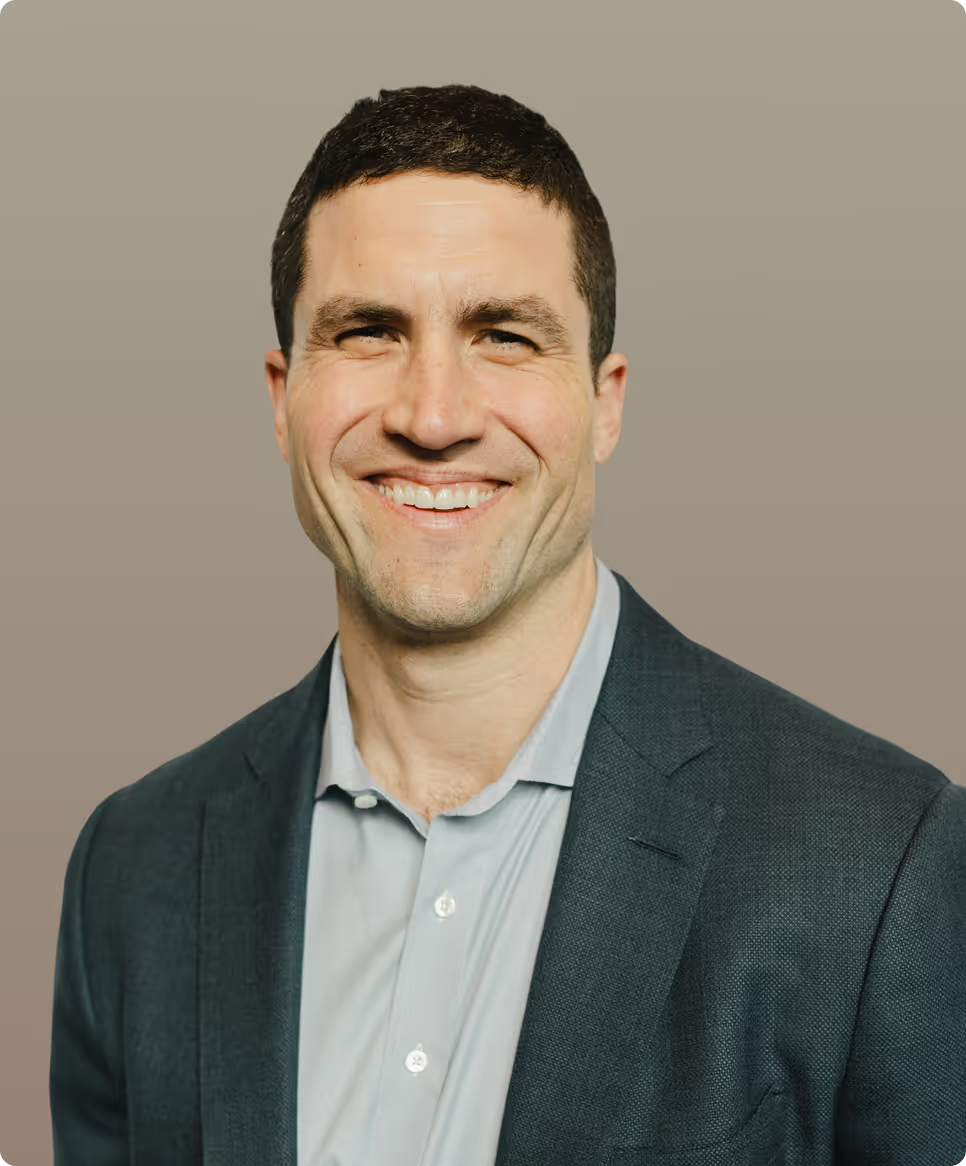
Alfred Johnson is co-founder and CEO of Crux, the capital platform for the clean economy. Before founding Crux, Alfred served as Deputy Chief of Staff to Secretary Janet Yellen at the US Department of the Treasury. Earlier in his career, Alfred was Vice President in Financial Markets Advisory at BlackRock, Senior Advisor for Financial Markets at the US Treasury, and Special Assistant to the White House Chief of Staff.
.svg)
.svg)
Share

.png)