Can US industrial trade policy stay on course?
Share
.svg)

.svg)
.svg)
About the episode
For decades, the United States bet on globalization: open markets, cheaper goods, and far-flung supply chains. But that model is breaking down. After pandemic disruptions and rising tensions with China, a new bipartisan consensus is emerging that America needs to rebuild its industrial base.
The real question now isn’t whether to reshore critical industries; it’s whether the US can do it consistently.
In this episode, we sit down with Sarah Bianchi, former Deputy US Trade Representative and current senior managing director at Evercore, to unpack the forces reshaping global trade, industrial policy, and investment. Drawing on decades inside Washington and firsthand experience negotiating trade deals, Sarah explains how we got here and why political volatility may be the biggest risk to America’s economic strategy.
Episode transcript
Sarah Bianchi: People do wanna be invested in the United States and I think the risk is the back and forth in politics. I mean, I, I think there are places where both parties agree, chips being one of them, that there ought to be, industrial policy to, to improve and secure the supply chain.
Alfred Johnson: for decades, America's leaders believed that open markets and global supply chains would deliver prosperity at home and stability abroad. But over those decades, we steadily lost the capacity to make things. And then came the pandemic, which exposed a deep dependence on goods made elsewhere. Then a wave of competition with China over semiconductors, critical minerals, and clean energy technologies. And finally, a political reckoning as both parties arrived from different directions at the same conclusion: America needs to reshore industry. The question is whether the US can follow through or whether that answer changes every four years.
Sarah Bianchi: It would be better if we all acknowledged that and tried to work together on it rather than again. 'cause I do think this back and forth is very challenging if you're an investor.
Alfred Johnson: This is Critical Capital. I'm Alfred Johnson, the CEO of Crux, the capital platform for the clean economy. America's renewed focus on industrial policy has brought radical changes to global trade. And if you wanna understand how trade policy actually gets made, you need someone who's actually been in the rooms hammering out deals. Sarah Bianchi is that someone.
Sarah spent decades in Washington, working across multiple administrations. Most recently, she was Deputy US Trade Representative for the White House, where she negotiated deals on energy and critical minerals. She's now a senior managing director at Evercore. She has firsthand knowledge of how US trade policy has been shaped, how it's changed, and how investors are thinking about the new landscape.
Today, we get into all of it: how America started to embrace industrial policy again, what tariff whiplash actually looks like from abroad, why critical minerals are really tough, and how political backlash against AI could impact the buildout of energy and data center infrastructure. She is exactly the kind of person you wanna talk to when the rules are changing, and right now, everything is changing.
Finally, a quick word before we get started. We discuss a lot of timely events in this show, and things could change. So this interview the state of play as of the morning of May 4.
Sarah Bianchi, welcome to Critical Capital.
Sarah Bianchi: Thanks for having me. It's great to be here.
Alfred Johnson: It's awesome to have you. I have enjoyed talking to you over the years about all of the kinds of things that we're gonna get into today, and the thing that I've enjoyed talking to you about is on the basis of your really unique perspective in this space. You've spent multiple decades in Washington. You've served in multiple administrations, and most recently you served as Deputy US Trade Rep responsible for Asia, Africa, energy transition, critical minerals. So bring a really, really rich perspective to the conversation. It's a remarkably tumultuous and fast-changing moment in trade and industrial policy, and things have changed so much over the last two decades. Can you just back us up and open the curtain on how we ended up where we are today and what it tells us about where we're going?
Sarah Bianchi: You know, I think you really have to go back to NAFTA and allowing China to join the WTO and a lot of trade decisions that actually, some of which fueled, but some of them also just happened at the same time as a lot of globalization. There really was a part of the country that didn't have new opportunities, felt hollowed out. I think that's been a theme that's kind of been underlying a lot of things for a while and kind of really hit its moment in some ways with President Trump kind of taking the mantle on tariffs and trade and questioning what was in some ways a bipartisan effort to do more free trade, even with the Transpacific Partnership at the end of the Obama administration really called into question. I think there became, as part of that, Biden and Trump, although very different, both have this kind of idea and notion of building it here, bringing manufacturing back.
That idea, I think, got even more momentum during COVID when we all learned what it means to have supply chains of that are vulnerable. It means not having things that we don't make here. And so now I think we're in this place where really there is bipartisan agreement that there are some things — not agreement on everything, but whether it be chips or other things — that we ought to build here. And there are also some places where free trade is not working, and so you kind of see it play out in different ways in different administrations. So for the Biden administration was a lot of incentives and the Inflation Reduction Act. For the Trump administration, it's tariffs and equity stakes in companies and price floors. Either way, it's here to stay. This notion of there are certain things that we have to build in the United States and certain places, or at least with partners and allies where not possible, and certain areas where we should be more skeptical of products, particularly coming from China.
Alfred Johnson: So I want to go a lot deeper on that — all of the implications of trade, tariff, and industrial policy on what we make in the United States and how the supply chains form. But before we do that, let's go deeper on setting the scene.
We are obviously in this moment of pretty significant instability and a lot of actual conflict. Let's start with Iran. So that is a situation that feels like it is in some form of fragile equilibrium, and it changes seemingly by the day. How do you see us unfolding from here? I noted also this morning that we saw gas prices hit a recent high. So we're in a moment where that conflict is starting to play through into markets in a pretty material way.
Sarah Bianchi: Yeah, and particularly outside the United States. We're still seeing it here in the US but Europe, parts of Asia that are dependent not only more on oil from the region, but also LNG and other things. Markets quite frankly, have been remarkably patient given the fact that right now the bid ask is still too high for resolution, and I think one of the things that we've learned and that the Iranians have learned is that, you know, we've always been extremely concerned about them having nuclear weapons, but in fact, they have this other nuclear option, which is closing the strait. I think we've learned between this and Ukraine and other incidents, the asymmetrical warfare, meaning that, you know, you can have the fanciest military and highest-performing military in the world, but if somebody can throw a drone from somewhere, it can really seize things up.
I think that the markets are gonna continue to pay attention because right now I think we are in this situation where Iran still kind of thinks it's winning and its pain tolerance is quite high. Now, that's not gonna be the case necessarily forever, but there really isn't even the room for the kind of deal that the President's talked about, which is much lighter in detail than other deals that we've seen in the past. But this notion of some kind of economic relief, for stopping nuclear and keeping the Strait open, right now that the deal isn't there.
People keep saying, you know, "Two more weeks, two more weeks!" At a certain point, you know, I think markets are gonna start to get a little nervous that it's not happening.
Alfred Johnson: Yeah, so it feels like we're in this new moment of leverage where countries are experiencing and starting to experiment with having economic leverage alongside strategic leverage. I saw that you made a comparison to the way that the Chinese used the ban on rare earths to what the Iranians have done with the Strait. What does that tell you about how, as these conflicts continue to metastasize, the different parties and countries that we'd be navigating with around the world may think about their leverage in Iran, China, and elsewhere?
Sarah Bianchi: Yeah, it's really interesting. I did a lot of travel in 2024 when a lot of countries in the EU and Korea, Japan, and in Asia were really thinking about the possibility that President Trump could return. They knew him as an actor, and so they were kind of like, "Well, how do we get along and make friends and get these dynamics?"
But now that's really shifted. And I do think China made the initial pivot. Remember, at the beginning of the Trump administration we were on what seemed like an unending escalation of tariffs with China — 200, 300, you know, that seemed to have no limit. And then the Chinese did something that they really hadn't done in Trump 1.0, which is they showed their leverage in a way that spooked the administration. Now we're sort of having conversations about detentes and a whole range of other things.
I do think Iran, there were some lessons learned there: Show your economic leverage against in these global conflicts, and it brings you as a much better negotiating partner against the United States. That is certainly the case today. We'll see going forward in other administrations if it remains to be a thing. But certainly with Iran and the straits, I think they've learned a lesson that will be enduring.
Alfred Johnson: Do you think that the Strait is a comparably profound point of leverage, and would that suggest that what'll happen from here will look like what happened there? What do you think makes this different?
Sarah Bianchi: Well, it is a point of leverage for right now. As you know, having dealt with a lot of critical minerals and things, figuring out how to mine and produce a whole range of minerals is a longer-term project than figuring out how to divert more resources out of the Strait or find other pathways, so it remains to be seen. But it's serious. I don't know how lasting and durable it will be, but it certainly is remarkable that even a country that is, by all accounts, experiencing a lot of pain right now — I mean, the United States military and the Israeli military did a lot of damage to the country, so we'll see how long it goes. But I do think this is, again, something that we'll start to see.
Alfred Johnson: What role do you see China playing in the background here, And how does the upcoming meeting that is planned for a couple weeks from now influence the span of potential outcomes here in your mind?
Sarah Bianchi: The way I think about China in Trump 2.0 is, first of all, we haven't really had a president with a halftime or a break like this. And so that gives everybody, including the president, you know, a whole way of thinking about how they might do things different. And I think China came into this administration thinking, "We are not gonna lose this opportunity where the United States is going to irritate some of its allies to show ourself and present ourself as a real leader on the global stage, as best we can." So I think as a general matter, they don't really want a lot to do publicly with this Middle East conflict. Obviously, they have their own economic stakes, obviously they're a player in the global economy, but they're not looking to come in and settle this out. They would prefer to show, "Maybe the United States didn't quite get this right. Look at us, this responsible global partner. Let's talk about all these other important matters."
Now that doesn't mean occasionally they don't have their own interests and call Iran and say, "It'd be great if you could take that ceasefire agreement," or whatever. They're active, but they're not looking to be the public face that we've seen from a Pakistan. There's some chance the summit could be delayed, although it's not my base case, but I think that summit — and, by the way, there's supposed to be four meetings between the United States and China — I think it is gonna feel very vague. No hits, no runs, no errors. Let's maintain this detente look. China has stuff it wants, it does not want the United States to go back to the tariff level that was in existence pre the Supreme Court decision. But I think in general, they're playing the long game here. They're looking to be a global responsible partner and try to keep things as calm as they can.
Alfred Johnson: So let's get into tariffs for a second. So there have been so many turns in the road over the last year and change, right? We find ourselves in a place where, as you describe it, there's a detente of a kind with China, but if you go back to the free trade era that we were in before Trump won, we're very clearly in a different one. The Biden administration maintained many of the tariffs on China, or some of them, that Trump had put in place the first time around. And then we had this notion of an across-the-board tariff and subsequent legal action and outcomes from the Supreme Court.
Where are we today? And and how do you see this continuing to unfold in the backdrop of the security situation that we just talked about?
Sarah Bianchi: The Trump administration is going to try to get back as close as they were pre the Supreme Court. I think their general posture is that they landed the plane on this. And they're not wrong in the sense that everybody said, "Oh my gosh, it's gonna be crazy inflation from this and tons of disruption!" and it hasn't really been that to the degree that people weren't. They are believers in tariffs — this guy has believed in tariffs since the 1980s. After the Supreme Court ruled, they put in place a global 10% tariff under Section 122 that allows you to do that on trade deficits, and then they launched a bunch of 301 investigations, which essentially is a legal investigation that can allow you to tariff or have other means to a partner.
And I think basically their plan is, by the time that this 122, which is in mid-July, runs out, they'll be ready to launch these 301s and by and large get us back directionally to where we were. Which, to your point is, when we started this administration, we were at about a 2% global weighted average tariff. Some of that, like you said, is from Trump 1.0. We kind of landed in the low to mid-teens. I think that's where we're gonna land when they're settled and done. Now, they may make some tweaks along the way, exempting food, exempting this or that. But I think directionally, we will end this administration in the low to mid-teens on a tariff rate. And as we saw with the last time, I think it's gonna be a lot harder for the next administration to unwind these than they might think.
Alfred Johnson: Sarah, when you were at USTR, you spent a ton of time with our allies in East Asia. I know you've been to Korea and Japan countless times, officially and since. When you're in their perspective — so these conglomerates that have invested so much in categories like semiconductors and electrical supply chain and batteries — what's the conversation like in capitals like Seoul and Tokyo as they look at evolving US policy on this?
Sarah Bianchi: Well, certainly there's frustration. Part of it is obviously they don't like tariffs, but also I think it's the whiplash. You know, they made all of these investments around the Inflation Reduction Act. A lot of the Biden rules took longer than they wanted or thought — they're not totally wrong about that — to get out the door. They see, even when we have a policy accommodations being made, so for example, the Biden administration exempted graphite from the minerals. Well, there's certain Korean companies that can actually make graphite. And so the whiplash, I think, is the hardest thing, and I think it is gonna be a challenge for industrial policy going forward if we can't figure out a little bit of how to stabilize that.
I would say right now, specifically, they're trying to get through the current phase, right? For Korea and Japan, that also means these investment vehicles. Japan has already made some investments. They've announced some, their process is underway. Korea's a bit behind. But I think they're also anxious about making sure that as these investment funds get deployed, that they are doing things that are otherwise in their best interest, that they're the kinds of investments you'd wanna make without that. So there's a a lot of anxiety.
Alfred Johnson: So let's back up on that, 'cause it's so interesting, right? We had this tariff regime that led to Japan and Korea offering these very large investment programs into the United States. I think it's $550 billion from Japan. Say a bit more about how that's anticipated to work. How do you think that the Japanese government and companies will navigate that? What will it mean to inflows of capital and to US infrastructure?
Sarah Bianchi: First of all, it's early days. Some of the language in the deals, again, the United States had a lot of leverage, particularly in Japan, because of the auto tariff that was quite concerning, and so they, were willing to do quite a bit to get rid of it. So the way the language in the deal works is not something any trading partner would like. You know, you receive the proposal, you get 30 days, yes or no. It doesn't feel the equilibrium. I think in practice so far, the kinds of deals that we're seeing are ones that the Japanese, that the JBIC are generally comfortable with. But certainly comes with a lot of anxiety coming down the pike.
The reality is, for both Japan and Korea, and the United States, they're critical partners for each other, right? The Japanese know, and the Koreans — I mean, these companies know how to do a lot of building and batteries and a whole range of things that are quite complimentary to the United States' skillset. As long as they can keep it and they're not being jammed on proposals that don't make sense... The first round of Japanese deals, I think — I haven't pressure tested each one — generally met that test. But there will be friction going forward. As you know from serving in administrations, they always want to ribbon cut and show progress, and this is pretty fast for a lot of these projects.
Alfred Johnson: I find it so striking because we're talking about infrastructure projects that take years to plan and execute in the context of policy that's shifting basically all of the time. One of the things that I've been reflecting on a lot is, you hear people give these very extreme takes on, "We are in the deglobalization era," or "the complete separation of these big supply chains," and I think the picture that you are presenting, particularly with allies like Korea and Japan, with whom we have such integration, is something that looks more like reorganization of the global economy, global supply chains.
Tell me how you think that plays out. If we're in this fragmented but reorganized world that continues to have some significant amount of interrelation and cooperation across allied countries, how does that play out in things like supply chains for components, critical minerals, and other things that are necessary?
Sarah Bianchi: In some ways it remains to be seen. From the Inflation Reduction Act, as you know, we saw a lot of investment, particularly a lot of Korean investment. We are seeing these Japan O-1s — again, it's early days, but they're happening. There are places where people do wanna be invested in the United States and, if they get a little government support along the way, that's great.
I think the risk is, first of all, the back and forth in politics. Trump is such a divisive character that almost seems like everything that he could do, instinctually the Democrats would hate. And so I think the risk is, again, you get a different president and they try to unwind this. I really hope that they don't, because that is the biggest concern. And look, some of what the Trump administration has done, quite frankly, on critical minerals, and I think you've seen some of the Biden people say this, actually not crazy. It's pretty good. You do kind of need a price floor. You do need some government intervention. You can't just have these ideological clubs that talk to each other. Somebody's gotta decide who's paying the price. And investors haven't been wanting to come into this space, so how do you get that done?
I think the biggest risk is the popping back and forth, 'cause no idea is perfect.
Alfred Johnson: One of the things that I found interesting there is you have this rancorous political reality where the two parties seemingly can't agree on anything, but then you have within this category of industrial policy and trade some amount of actual coherence. So I was looking at the recent way in which the markets for batteries in the United States and grid connection of utility-scale batteries are objectively booming. If you play that back, that started with a tax credit that went to batteries as part of the Inflation Reduction Act. It, along with nuclear and biofuels and critical minerals and a bunch of these other categories, was retained in full in the tax law over the summer last year. And we have an industry that's that's booming by every possible measure. When you think about that, is there actually more coherence on aspects of industrial policy than it feels like there is based on the way in which the conversation happens?
Sarah Bianchi: That's right. I think there are places where both parties agree —chips being one of them — that there ought to be industrial policy to improve and secure the supply chain. I think the IRA probably would have been a bit more durable — maybe it was too early in that moment — if it had been talked about as, "AI is coming, we need energy, data centers." I think the electric vehicle centerpiece of it got it off a little sideways and enabled Republicans to make fun of it saying, "These guys don't want you to drive a gas car." I think it is best when it is clear what the security nexus is, like the Chips Act.
Now, this isn't always gonna work, and I do think it's really important that policymakers take a hard look at, first of all, what are the industries they're talking about? Again, I think it makes sense when there's a security nexus. Also what's realistic? If you're looking at something like shipbuilding, is that something realistically that the United States can catch up on and compete on in an amount of time, or is a different kind of partnership relevant there? Those conversations are a little hard to have in some senses because there's different stakeholders who want different things, but directionally, I think it is a through line and it would be better if we all acknowledged that and tried to work together on it rather than... Because I do think this back and forth is very challenging if you're an investor.
Alfred Johnson: It's interesting how the rationale for some of these things has shifted. Critical minerals is an interesting example of that, where the way it was rationalized as part of the IRA was as the necessity to have the components to be able to do the energy transition, and now it's front and center in this increasingly broad trade battle that we are in with China and increasingly seen as this strategic asset that we have to have.
I wanna pull on your thread of realism for a second, because the reality of that supply chain is that it's not here. We've got a little bit of of development, and there's more things that are contemplated, but basically all of the critical minerals and rare earths are produced in China, and a huge amount is refined there, even if it isn't produced there. So talk about that supply chain and how it is vulnerable and the the ways in which investors may be taking advantage of this current moment to present some new formulation of it that is more sustainable for the US and our allies.
Sarah Bianchi: It's a great question. I do think you really have to almost go mineral by mineral. There is some lithium in the United States. There's new ways of extracting it that are really promising. There's some good projects. The processing part remains a challenge, right? I mean, if you can extract it here and then you gotta send it somewhere... In some senses, I think some of the technology is and will catch up. So like now you can direct lithium extraction without as much challenging on the mining side. But it is a challenge, and I think it is better — and this is where I will the give the Trump administration some credit. Sometimes I think people think, "Well, we'll all just get together and talk about it, and we'll have a group or some club where we get our minerals together." Well, that's actually a really challenging thing to get done because when you're seeing the Trump administration is trying to get a few one to say, okay, but we're gonna have to pay a price to get this investment here. And then it's like, "Well, I don't wanna pay higher. Well, the automakers don't want me to pay higher."
I think you've really gotta go in with some hard-knock economics and investment realism and just understand that people don't wanna necessarily pay more just 'cause it feels good to have their own supply chain and just to be very clear-eyed. And again, there are certain minerals where that's super possible, but there's others where it's more challenging. I do think that sometimes you see policymakers thinking, "Well, if we're just all in it together, we'll work it out and get it done." But these are very challenging. Even our allies, negotiating with them is quite challenging, so I think that's really important.
Alfred Johnson: It's interesting 'cause the math has to math, right? You take something like lithium, and it got a pretty significant tax credit as part of the 45X tax credit regime. And as you mentioned, there is a lot of promising technology and some exciting projects there. But the other thing that has happened in the last few years is that the price of lithium internationally has cratered as China has brought a lot more to the market, and that has led to some of these projects being canceled or stalled. That then presents this question of: do we want that industry in the United States or not? And if we do, what is the necessary set of incentives to bring it here and get it built?
It feels like we haven't yet solved that problem in a way that will really bring these supply chains back. Is that how you see it?
Sarah Bianchi: Like you said, we see really promising signs, and I think lithium's a good example of where there are some promising signs, because you're just going to need it, so you can get offtake agreements and the like. But look, I do think experimenting with offtake agreements, experimenting with price floors, I think all of that is really important to think about when you're trying to get this done. Again, people who just think, "We can have a club and all agree," are just not — we tried to do that in the Biden administration with the global arrangement on steel and getting Chinese steel out, and that didn't really get anywhere 'cause everybody has their own interest.
It's very challenging to get the kind of, where do you want your policy to fill the gap? Energy loans, a whole range of places can do that, but that is gonna be, on the mineral side, where the rubber meets the road. And again, it's different for different minerals, but like you said, when you have the main supplier, at least of processing, willing to flood the market, you've gotta figure out what you wanna do about that.
Alfred Johnson: You have all of these complex, intersecting strategic and competitive things that are happening at the same time. We haven't even talked about AI. AI is driving a huge amount of energy investment. It's driving up prices domestically. It presents this new geopolitical strategic axis that countries are competing on. How do you see that entering the picture here as we think about our relationships with international allies, adversaries across the board?
Sarah Bianchi: It's a great question. I think, first of all, we are seeing the rumblings of a political and policy backlash against AI. This president has taken, at least in Trump 2.0 — it's kind of interesting, because he went pretty hard after some of the tech companies in Trump 1.0 — he's taken the view that when you're in a strategic competition, you just gotta unshackle and try to win the race. That's not where the American people are. That's not where a lot of Republicans are, like DeSantis in Florida. What we try to tell market investors is, look, this is the peak of supportive government is right now on AI. Today. As we get through these midterms, we're gonna have — you tell me how many people are running for president. If it's sub 30, that'll be a nice, low number.
Alfred Johnson: I'll take the over on 30.
Sarah Bianchi: Okay, there you go. And look, people are looking for lanes, right? So of course there's gonna be a lane that says cancel. Stop investing in data centers. I try to tell equity market participants, when Bernie Sanders was talking about Medicare for All and running second in 2019 and 2020, the healthcare stocks, they took quite a multiple hit. I remember thinking, "I don't think Bernie Sanders would be the president. If he does, he doesn't have the votes for Medicare for All. So why do we care?" But I do think the sentiment is gonna really start to shift.
There is also gonna be some strange bedfellows in in this. I think even people like Steve Bannon have said that MAGA's really nervous about AI. I think we are in for a whole slew of conversations in this space that people aren't prepared for. And again, a lot of these companies, make up significant part of the market cap of the S&P. So, I think we're in for a world of challenges.
Alfred Johnson: There's an interesting parallel to draw. We talked about a moment ago how in industrial policy there may actually be somewhat more alignment than people give credit for. I expect if there are those 30 candidates and there are 15 on each side that are running, there will be people on both sides that fully occupy that lane. So this is an interesting political issue that seems to be bending across and creating these different groups on either side, and that may drive some amount of alignment.
How do you see that playing out as we get through the midterms and start to get into the presidential race? The backlash is obviously something that is quite prominent right now. The models are only getting better. What do you see as the ways in which this is gonna evolve from here?
Sarah Bianchi: First of all, you're seeing a lot of state activity, right? It's kind of expressing itself in data centers. Some states like Florida, California are starting to do more comprehensive kill switch, all that kind of stuff. It's kind of amazing when the heroic company is the one that says, "I'll give the Defense Department a lot of stuff, but not the one that can lose control and kill us all. Maybe that's a little bit of an exaggeration, but we've seen it in tech. We're starting to see it in big tech where people are really anxious about social media. The Supreme Court took a case on a law in Texas that said for kids, you can't program this stuff to them. The algorithm just can't do that. That was Texas, and Florida had a state law. So I think you're gonna start to see it in the states first in addition to in the presidential debate.
Honestly, I don't think really anybody in Washington's quite prepared for it. That always gives you the risk that all of a sudden a hammer can come through that you don't notice, like, "We gotta get rid of TikTok" — just the quick, blunt instrument. But, yeah, I think that the jury's really out on this. Some of these companies might just decide they're better off negotiating reasonable guardrails than they are kind of like letting all flowers bloom.
Alfred Johnson: It's this really strange moment, because there's this objective volatility that's happening everywhere around us, and the systems that we operate within are shifting, and this new technology is before us that seems like it's the most powerful technology potentially we've ever created. And we see equity markets reaching daily all-time highs, even as oil crosses a hundred. So it's this complex set of factors that seem to be playing out in risk assets in a different-than-expected way. How do you make sense of that?
Sarah Bianchi: What do I make of it all? I mean, it's not totally fake, right? There's actual real things associated with it. I just think the implications are gonna be profound. And the challenging thing is, and I'll say this as a policymaker myself, it's hard to know — like when we did the chip export controls in the Biden administration, to get the level of expertise to understand that this chip can do this and that one isn't safe, you gotta really know stuff. And I always think of that line that Justice Elena Kagan said after one of the cases around big tech. She's like, "You know, we're not exactly the nine most experts on the internet up here at the Supreme Court." And I think that is a challenge, because this stuff was moving so fast and it's hard to kind of figure out even who understands it.
In some cases when those things happen, policymakers do nothing, and in some cases they use blunt instruments: let's ban this product. I think that remains to be seen, but if this is as promising as people say, I think the volatility is only gonna grow in the next couple years.
Alfred Johnson: It's funny because even though that's the case, I find it hard to make the bear case on US energy and manufacturing infrastructure. There are just so many factors that point in that direction. You've given a lot of them: This increasing competition that we have, rising energy prices, AI, all points in this direction, that all builds upon this environment that you talked about being in the wake of COVID when we had to rebuild these supply chains. So if we're moving in that direction, can you make the bear case there?
Sarah Bianchi: For the manufacturing and energy thing, I agree with you. I think it's bullish. Because even if we clip the wings of this thing by 20, 30%, there's still a lot of investment that needs to happen. I would say the aspects of it that I am more bearish on are the things that really require a lot of permitting and long-term investment to get done. I just think we've seen this in the critical mineral space. It's very hard for an investor to put money into something that might take a very, very long time and, by the way, when it does, the price could be somewhere between, you know, 1 and 100X. That's just not the kind of certainty people look for.
So I think there are some of them where this kind of "Big Tech, break, it, Silicon Valley" attitude meets like state regulatory processes, and it's pretty tough. So I think there's some places where regulatory barriers could win in that.
But generally, I am bullish. And also I think it's interesting — the good thing about these companies is they can pay for it, right? And so I do think there are creative solutions around data centers and the others. Make your own power, get your own... There are a lot of bullish aspects and I think the regulatory gridlock of getting projects underway — again, you've probably seen more of this than me — but in some, in some areas, I think it's gonna still be hard.
Alfred Johnson: I'll bring you to a last, hopefully optimistic question. You have spent a lot of time at this intersection of policy and markets and companies, and you know how all the different pieces connect. If you could snap your fingers and fix one thing about the system, as the system is currently constructed, what would you do?
Sarah Bianchi: Well, I do think this durability issue's really important because investors do not — you can't run a model if it's just gonna be overturned. It's almost a joke — each administration comes in and there's 9,000 regs that go to OMB to undo the last guy's thing. But if you can gain the trust that at least it's gonna be durable, I do think that will be helpful.
Alfred Johnson: Yeah, no way to run a railroad. You can't invest in a railroad if you don't know if the track's gonna be there when the next administration comes in.
Well, Sarah Bianchi, thanks for coming on Critical Capital.
Sarah Bianchi: Thanks for having me.
Alfred Johnson: Sarah Bianchi is Senior Managing Director and Chief Strategist of International Political Affairs and Public Policy at the investment bank Evercore. And as you could probably tell, she spent decades in Washington working for multiple administrations, most recently as Deputy US Trade Representative responsible for clean energy and critical minerals.
I love hearing Sarah's takes on what's really happening with US trade policy. If these are the kinds of conversations you love to listen to, think about subscribing to us on Apple, Spotify, or wherever you get your podcasts.
Critical Capital is a co-production of Crux and Latitude Studios. Our production team includes John Sheehan, Jenna Herzog, Steven Lacey, Anne Bailey, and Sean Markwand. It also includes Emily Hughes and the excellent team at Crux, the capital platform for the clean economy. I'm Alfred Johnson. Thanks for listening.
Critical Capital is a co-production of Crux and Latitude Studios. Learn more about how Crux is financing the future of energy.
Want to explore more conversations like this?
Browse all episodes
Hosted by
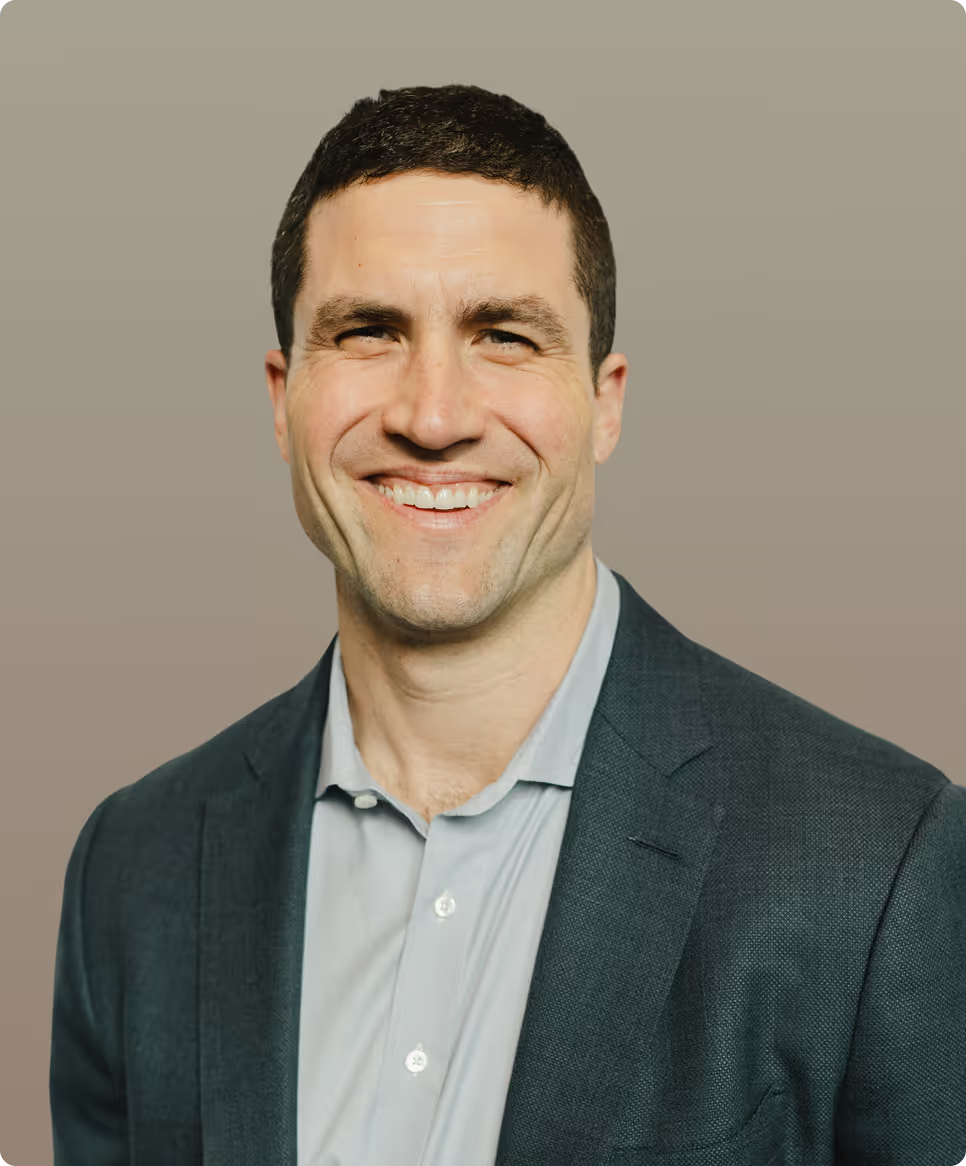
Alfred Johnson is co-founder and CEO of Crux, the capital platform for the clean economy. Before founding Crux, Alfred served as Deputy Chief of Staff to Secretary Janet Yellen at the US Department of the Treasury. Earlier in his career, Alfred was Vice President in Financial Markets Advisory at BlackRock, Senior Advisor for Financial Markets at the US Treasury, and Special Assistant to the White House Chief of Staff.
.svg)
.svg)
Share