Rapid response: Implications of beginning of construction ruling for wind and large-scale solar
Share
.svg)

.svg)
.svg)
Want to explore more conversations like this?
View all blogs
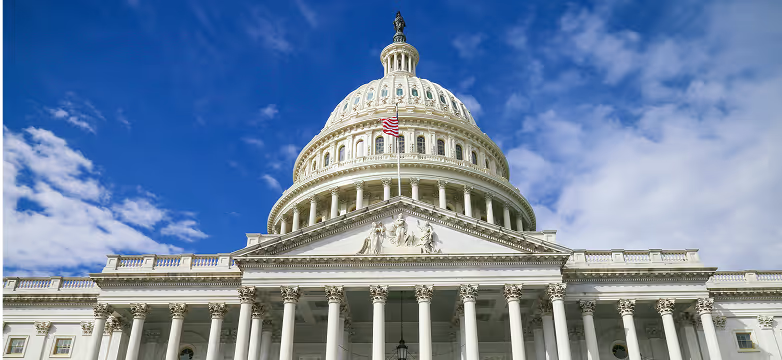
Yesterday, the U.S. District Court for the District of Columbia vacated IRS Notice 2025-42, restoring the 5% safe harbor as a valid method for wind and large-scale solar projects to establish beginning of construction under the §45Y and §48E technology-neutral tax credits. The ruling comes 27 days before the July 4, 2026 beginning-of-construction (BOC) deadline.
The ruling rejects a highly publicized piece of the Administration's clean energy enforcement agenda and reinstates a pathway developers had been planning around prior to the issuance of the Notice last August. It's a significant legal development, but it also introduces significant uncertainty.
Background
Notice 2025-42 was issued in August 2025 pursuant to Executive Order 14315, which directed Treasury to "strictly enforce" the credit termination dates for wind and solar established in the One Big Beautiful Bill (OBBB). The notice eliminated the 5% safe harbor for all wind projects and solar projects larger than 1.5 MW, leaving the physical work test as the qualifying method to establish BOC for those technologies. The safe harbor, available since 2013 and reaffirmed in IRS guidance since, had previously allowed developers to demonstrate BOC by paying or incurring at least 5% of a facility's total depreciable costs.
What the court found
The court found Notice 2025-42 arbitrary and capricious under the Administrative Procedure Act on three grounds.
- Inadequate reasoning. The notice's rationale fit in a single paragraph and never explained the rationale for removing the 5% safe harbor. For example, the rationale did not justify how projects satisfying the safe harbor were "circumventing" statutory deadlines or engaging in "artificial manipulation of eligibility."
- Unjustified technology discrimination. The notice applied different standards to wind and large-scale solar than to other clean energy technologies — despite §45Y and §48E being explicitly technology-neutral and despite multiple commenters flagging that asymmetry before the notice was issued.
- Failure to consider alternatives and reliance interests. Treasury received specific proposals for targeted interventions before issuing the notice — restricting the safe harbor only for purchases from foreign entities of concern, and new reporting and audit requirements — and the record shows no evidence those were weighed. The court also found that the credits are subject to serious reliance interests. Notably, the court rejected Treasury's argument that the §45Y and §48E credits are "of recent vintage" and therefore not subject to reliance interests. The more relevant analysis, the court held, is how long the 5% safe harbor has existed as a BOC concept: since 2013, reaffirmed consistently by Treasury and the IRS, with Congress amending the credits multiple times and never once directing Treasury to change the standard.
The court ordered full vacatur and remanded the matter to the IRS for further administrative action.

Get our latest insights and favorite reads on the transferable tax credit market in your inbox.
What this means for developers
The 5% safe harbor is restored, effective immediately. But the set of net-new projects that can actually act on this before the July 4 deadline is limited. Still, developers should revisit their BOC strategy and consult advisors to assess potential changes to their strategy.
Projects larger than 1.5 MW that were already on track to satisfy the physical work test have little reason to change course, unless the 5% safe harbor can meaningfully strengthen their BOC position. The projects that stand to benefit most are those that had already incurred 5% of total costs – or could in the next 27 days – but can’t establish meaningful physical work before the July 4 deadline. Because there is some uncertainty as to whether this court decision will be the final word on the issue, projects that establish BOC under the 5% safe harbor between the notice’s original effective date and July 4 will carry elevated eligibility risk. Given the possibility of additional litigation and regulatory developments, buyers, investors and lenders will discount that pathway until there's more legal certainty, impacting the marketability of credits tied to these projects. Whether insurance markets will cover that risk is a question we're monitoring closely.
The prohibited foreign entity (PFE) provisions of the OBBB are unaffected by this ruling. That said, the decision may indirectly shape forthcoming Treasury and IRS guidance on PFE and other OBBB implementation rules — pressuring the agencies toward a more robust approach to justifying their decisions in order to avoid reversal. More deliberate rulemaking could ultimately impact the timing and substance of future guidance.
Next steps
The Administration may seek a stay from the D.C. Circuit. If granted and the decision is appealed, Notice 2025-42 would remain in effect while the appeal proceeds — which, as the court itself acknowledged, will almost certainly extend past July 4. Market participants should plan accordingly.
Treasury also retains authority to issue new BOC guidance. A more fully reasoned notice that addresses reliance interests and considers targeted alternatives could survive APA review. In other words, the court ruled on the process, not the outcome.
We'll continue to monitor developments and keep clients and partners apprised. Crux clients receive additional in-depth memos and custom briefings. To access these insights, get started with Crux today.
Share

















.avif)