The US-China rivalry runs through energy and minerals
Share
.svg)

.svg)
.svg)
About the episode
On today’s stage, China is the rising global power, and US dominance is under threat. Geopolitical tensions like wars in the Middle East and Ukraine, combined with supply chain disruptions and a growing demand for rare earth minerals, continue to strain the relationship. But that relationship is key to the future of energy in the United States.
In this episode, Alfred Johnson talks with Harvard professor and geopolitical strategist Graham Allison. Together, they unpack the growing rivalry between the United States and China through the lens of the “Thucydides Trap,” a concept Graham popularized in his book Destined for War. The “Thucydides Trap” is the idea that when a rising power threatens an established one, conflict often follows.
Drawing on history and decades of foreign policy experience, Graham explains how today’s US-China relationship resembles past global power struggles. He also explains how economic interdependence complicates the rivalry, and why energy, rare earth minerals, Taiwan, and global supply chains have become central geopolitical battlegrounds.
Critical Capital is a co-production of Crux and Latitude Studios. Learn more about how Crux is financing the future of energy.
Episode transcript
Graham Allison: "When a rapidly rising power like Athens, or China today, seriously threatens to displace a major ruling power like Sparta, which had been the dominant power in Greece for a century, or the US, which has led the world for a century, normally, the outcome is war, frequently a catastrophic war."
Alfred Johnson: During President Trump's visit to Beijing, China's President Xi referenced a political theory in his opening remarks that has been part of foreign policy commentary for decades. The Thucydides Trap takes its name from the ancient Greek historian who chronicled the Peloponnesian War more than 2,000 years ago, and it states that when a rising power threatens to displace an established dominant power, the end result more often than not is war.
On today's global stage, China is that rising power, and America's dominance is under threat. While it's true that the two countries are closely linked through trade, markets, and culture, wars in the Middle East and Ukraine are disrupting energy markets and supply chains. China is using commodities like rare earth minerals as leverage, while the United States is imposing hefty tariffs. Both countries need the other, but tensions are rising. It's all part of a global power play.
So the question remains: can these two superpowers continue to compete without sliding into conflict?
Graham Allison: "This is a classic Thucydidean rivalry, and I think both President Xi and President Trump understand it in those terms."
Alfred Johnson: This is Critical Capital. Welcome. I'm Alfred Johnson, the CEO of Crux, the capital platform for the clean economy. Today we're talking about the forces reshaping global power dynamics with Graham Allison, one of the world's leading scholars of geopolitics and statecraft. He's the founding dean of the Harvard Kennedy School, a longtime advisor to US presidents and defense officials, and the author of Destined for War, which popularized the concept of the Thucydides Trap.
We talked about the two countries' evolving relationship, how energy markets and rare earth supply chains have become geopolitical weapons, and whether Trump and Xi can navigate this period of disruption without repeating the mistakes of history. Graham Allison, welcome to Critical Capital.
Graham Allison: Thanks for having me.
Alfred Johnson: I have to say, it is a unique privilege to have you on the show. I have known you for as long as I can remember. You were my advisor and professor at the Kennedy School, and you have written what is the definitive book of this present era, where you ask the question of, "Can the US and China avoid the Thucydides Trap?" Which was incidentally the same question that President Xi posed at the top of his remarks in the recent summit with President Trump. Can you just step back and say what is the Thucydides Trap, and how do you think it explains this moment that we're in?
Graham Allison: Thucydides was the father and founder of history. He wrote the first ever history book. It was called The History of the Peloponnesian War, and it was an account of what happened when Athens rose to rival Sparta four centuries before Christ. So this is a long time ago. But the book is brilliant. Every page of it is exciting.
He has many big ideas, but one in particular that I helped highlight by coining the term "Thucydides Trap" is his proposition that when a rapidly rising power like Athens, or China today, seriously threatens to displace a major ruling power like Sparta, which had been the dominant power in Greece for a century, or the US, which has led the world for a century, normally, the outcome is war, frequently a catastrophic war. So his famous one-liner is that it was the rise of Athens and the fear that this instilled in Sparta that made the war almost inevitable.
And Thucydides's insight was this is about human beings, and it's about animals — if you take the alpha wolf and a challenger. It's about companies — an established company and a disruptive upstart. But it's also about countries. Thucydides was particularly interested in countries. So this discombobulation magnifies misperceptions. It multiplies miscalculations. If we go back to another famous example, the rise of Germany in the period after 1870, and particularly at the beginning of the 20th century, to rival Great Britain, in those circumstances, something as bizarre as the assassination of an archduke in Sarajevo, a little teeny spark, can become a fire that can become a conflagration that ultimately burnt down all of Europe. How could that happen? The answer is, under those circumstances, people misperceive, they misjudge, they miscalculate, and that can create a spiral that produces an outcome that nobody wants.
If you go back again to World War I, when you get to 1918, every one of the combatants has essentially been defeated except for the US, who comes late to the war. So if you had given the leaders of Germany or Great Britain or Austria or Russia a chance for a do-over, they would not have made the decisions that they made. But they made the decisions not expecting the reactions, and they got themselves into a spiral, and that ended in a war.
So I think the big picture, trying to understand what's happening in the relations between the US and China today is to understand: this is a classic Thucydidean rivalry, and I think both President Xi and President Trump understand it in those terms.
Alfred Johnson: Graham, with that as the context, President Trump was in Beijing recently, and he was meeting with President Xi, who seemed to deeply understand and even reference this as the context. In a piece that you wrote shortly before President Trump arrived, you said that there would be four-to-one odds that both sides would declare it a great success.
If you're the oddsmaker, do you think that you'd be paying out now? Do they both see it as a great success?
Graham Allison: Well, I think if you look and see what each said about it, both there and in the aftermath, I would say it was not difficult to predict that they would call it a great success. Now, we could then have a more complicated issue of how successful for whom in doing what. But I think they both wanted a success.
The meeting was actually very well prepared in that regard. The Secretary of the Treasury, Scott Bessent, and his team, and his counterpart, He Lifeng, and the Vice Premier and his team, had worked together to put everything more or less in order. The US Ambassador, David Perdue, had worked very hard on, again, back-channeling in setting things up. So I think the parties declared this to be successful.
Alfred Johnson: I would say not particularly spectacular or not particularly dramatic, but very important. Having the two leaders of the two most important countries in the world talking privately, candidly, in an extended manner about their shared interests and shared risks is very important.
One of the things I've always loved about your approach to analyzing present dynamics is you look so deeply at the history of things. In 2013, you published this great book about Lee Kuan Yew, who was the forefather of modern Singapore. In that book he says, "To understand the present and anticipate the future, one must know the past enough to have a history of the people." We have these two countries that are increasingly co-equal in the United States and China, but we get to that place from such different origins. How does the background and our collective histories impact the way that both sides are approaching this present moment?
Graham Allison: That's a great question, and you're absolutely right that that's something that Lee Kuan Yew observed. So in the Chinese story, which he would always say Americans needed to study more, China's history says China was the center of the universe for all of history until the last two hundred years when Westerners, with technology, showed up to humiliate China in what they call the century of humiliation.
So in that way, leadership of China, Xi Jinping and the people who work for him, and most thinking Chinese, see what’s happening now, they call it making China great again. Jinping's version of this, which was out before Trump's, was called the "Great Rejuvenation of the Great Chinese People." So that's what they think is happening.
Now, switch over to Americans today. You and me, we've grown up in the American century in which an America that led the world in defeating Nazism and Japan in World War II then created a whole new international security order — a pretty amazing international security order in which people as old as I am have had an opportunity to live our whole lives without great power war.
I wrote another piece recently in Foreign Affairs called "80, 80, and 9." Three numbers. Each of them is the answer to a question, and if you can identify the question, you've got the big picture for international security in the lifetime of everybody on Earth today. The first 80 —how many years has it been since a great power war?
Alfred Johnson: Eighty.
Graham Allison: Eighty. Okay, how amazing is that? That’s the longest period of peace without great power war since the Roman Empire. This is very unnatural. Who was the architect and who's been the guardian of that? The US. That's both true, but that's also what Americans believe if we think about our history. Second 80 — how many years since nuclear weapons were used in war?
Alfred Johnson: Also 80.
Graham Allison: How amazing. That didn't happen by accident. That's, again, American leadership in creating a whole order.
And nine — how many states have nuclear arsenals? Only nine. JFK in 1963, said there were gonna be 25 in 1970, and that would've been normal. So what's prevented that happening is not just nature. That's been the undertaking of the Americans as they've led this international order.
So from an American history point of view, China's attempt to displace us from our natural place at the top of every pecking order seems threatening. I mean, it is threatening.
Lee Kuan Yew was brilliant in this regard. If you and I were Chinese, we would probably see things more or less the way they do. And if they were Americans, they would see things more or less the way we do. So that doesn't give either of us a pass. That means we should appreciate the complexity of the motivation in this rivalry. It certainly doesn't tell us what the conclusion is, because if we, again, take Thucydides seriously, the normal outcome of this would be a catastrophic war. So if business as usual or diplomacy as usual would forecast history as usual, and that would be catastrophic for ourselves, Thucydides would say, and I would say, "That's why we gotta do better than that."
Alfred Johnson: So Graham, we just explored the history of the way that the different countries approach the moment. The summit also exists within the context of present history, and if you take that "80, 80, 9" world that we've been living in, that's also been a world that has centered the US economically and with respect to trade. We've been living in this long dynamic with China, where we've been running a trade deficit relative to them. That was the auspice by which the tariffs were suggested last year, I think, ultimately reaching something like 145%. There were reciprocal tariffs from the Chinese side. And then the Chinese effectively put a gun on the table in the form of the rare earths and critical minerals export restrictions.
How did they think about using that point of strategic leverage, and how does it bring us forward to the moment that we're in now?
Graham Allison: Great. I see you've been doing your homework.
Alfred Johnson: You taught me.
Graham Allison: The thing is, in Trump world, things have been moving so fast that it's very hard to keep track. Not only, as you said, did the Chinese put the gun on the table, they fired it in the air a couple of times to get our attention.
If we go back just a year to April 1, 2025, the so-called Liberation Day, Trump imagined that tariffs were a magic wand that he could just wave and other countries would bow. When he waved this magic wand with Xi, first to 40%, Xi matched him. Then 60%, Xi matched him. One hundred percent, Xi matched. One hundred and forty-five percent, Xi went to 125%. So Bessent said, "Excuse me, let's just stop this. This is an embargo." Not only then did Xi go to 125%, he choked supply line for rare earth magnets and a number of other items without which the US economy can't function.
So as he choked this supply line of something that most people had never even heard of or thought about our vulnerability. Within a week, the F-35 or the Ford Explorer or many other production lines were looking at closing down. Just in a week or two. So Trump quickly did a backflip because you can't have the American economy closing down. And not only did he do a backflip in public, he then described it so candidly that I was embarrassed, okay? That it's like to say, "Okay, you caught me with my pants down, and now I have no pants." I would try to cover it up somehow, not make it so vivid. But both he and Secretary Bessent have talked about this candidly.
So now we find ourselves in a relationship with China in which they're entangled in our economy and society and dollar and international trading system, and we're entangled in their supply lines so deeply that we're trying to come to grips with the fact that actually we have to find a way to live together in order to keep each of our own economies working. So it's easy to say we're great power competitors or, in my terms, lucidity and rivalries, rivals. It's harder to recognize that we're living in conditions in which each of our own survival and wellbeing requires a level of cooperation with the other.
Alfred Johnson: So Graham, you have this increasing competition, this opportunity for cooperation. I'm struck by the complexity of the relationship that you just can't reduce to any one thing because you have so many things on the table, right? You have beans and beef and Boeing. You have the trade relationship. You have the relationship of our currencies and how it impacts the relative economic positions of both countries. And then there's this little island off the coast of China, where the overwhelming majority of the world's advanced semiconductor capabilities reside. How do you see Taiwan fitting into the picture here as we process what may happen as the two sides understand what the new dance that we are in sounds like?
Graham Allison: Again, great question, and there's three or four components of it, so I think you're absolutely right that this is complex. So friend or foe, that's simple. And what if you say both? Complicated. Complex. In the business world, as you know, there's a term that sometimes in business schools they call co-opetition. So it's competition and cooperation. A great example of this is Apple and Samsung. So Apple and Samsung are fierce competitors selling smartphones. Actually, Samsung has been number one globally for the last five years. Apple is number two, okay? But who is the major supplier of components for Apple's smartphones?
Alfred Johnson: Samsung.
Graham Allison: The answer: Samsung. And when I asked Tim Cook about this, I said, "This makes no sense. You're fiercely competitive with Samsung, and yet you're dependent on them for the supply of the critical items for your iPhone, which is competing with them." And he said, "Life is complicated."
So life is complicated, or, as you say, complex. So can Americans and American strategists become as sophisticated in dealing with and living with complexity, and can the American public tolerate a degree of complexity that great company leaders have managed?
That is a good question, and it's unclear. Now this, as you say, manifests itself in 50 or 100 different arenas, the most dangerous of which is Taiwan., From a Chinese perspective, Xi and every influential Chinese believes that Taiwan is an integral, inseparable part of China. If the choice is between an independent Taiwan and war to prevent an independent Taiwan, Xi believes, and I believe, that China would choose war, even though that war might be ultimately catastrophic for China. So another way to put it is no Chinese leader, certainly not today or in the foreseeable future, could survive a Taiwan that had become an independent country. He would be overthrown by his own government. So that's unacceptable for him.
On the other hand, from the American perspective, Taiwan has been an issue since the re-establishment of relations between the US and China back more than 50 years ago, when my mentor and friend Henry Kissinger and Zhou Enlai sat down to try to develop what became ultimately a re-establishment of relations. And in that effort, they accepted a framework that's sometimes described as strategic ambiguity, in which China agrees not to use military force against Taiwan as long as it doesn't cross its red lines. On the other hand, the US threatens to come to the defense of Taiwan if it should be attacked by China.
Even though it's not elegant, and even though it's confusing and complex, it shows you that issues that are irresolvable are not necessarily unmanageable.
Alfred Johnson: So Graham, as you looked at the 16 conflicts that were Thucydidean in some way or another in your 2017 book, one of the things that was striking to me is that sometimes the tinder was there in the potential great power conflict, rising power challenging an established power, and the spark came from this external force. You made reference to the assassination of the Archduke Franz Ferdinand in Sarajevo in 1914. You wouldn't have anticipated that that was the thing that cascaded into World War I.
We have another big spark that's happening in the world right now in a different strait, in the Strait of Hormuz. How do you see what's happening in Iran in the context of this global great powers competition that we're in today?
Graham Allison: Big question, interesting. I don't see a clear path from this to a conflict with China. In this instance, China's interest and the US interest in reopening the Strait of Hormuz in order to restore the supply of energy are similar. The impact of the embargo in basically shutting down about 20% of the supply of oil to the global market has been this huge spike in the price of oil, but that's happening to both the US and China.
Actually, the Wall Street Journal's number of the day the other day was 45 billion, which is how much more Americans have paid for energy since Trump attacked Iran —45 billion. That's a big number. I think that's a bigger number than China, because supply of energy from oil is a much smaller portion of its energy for meeting its energy demand.
So the shared interest of the US and China in reopening the Strait is one that I'm sure President Trump and President Xi talked about. They didn't say much about it in public, and I think the Chinese position is complicated. I don't see how China gets entangled in this deeply enough for it to lead to a US-China conflict, but maybe I'm not being imaginative enough.
Alfred Johnson: I think, Graham, even if you're thinking about a standalone conflict, it still has all these cascading implications, the most obvious of which is energy. In your book about Lee Kuan Yew, there's this moment where you're talking about the 1970s where Zhou Enlai and Kissinger were navigating the first version of the US-China relationship in the American Century. In that same era, we were seeing the Iranian Revolution and the oil shocks that were related to that in the 1970s. How do you see the lessons of that prior experience as they apply to today?
Graham Allison: That's a very good question, and again, this is in your space, so I should be asking you, but I'll offer my two cents, then you tell me what you think. So energy is obviously a prerequisite for economic growth and most everything else that we care about. And the global energy markets have, somewhat recklessly, imagined that globalization allowed for secure supply lines without interruption, even though history repeatedly shows that there have been substantial interruptions. As a result of the previous interruption, we created a strategic petroleum reserve, because if you get to the point where Americans are waiting at filling stations, they become very, very angry, as President Carter came to understand.
So, the US Strategic Petroleum Reserve has been one big one, but the Chinese have also had a big strategic petroleum reserve. And interestingly, in January and February, long before the February 28 attack on Iran, there was only one country that's had substantial increases in its strategic petroleum reserve, and that was China, where they had huge increases both in January and February.
They've also been diversifying their sources of energy supply, including in particular green. So China has built up its solar world, its wind world, its nuclear world, so that oil and international oil is a very small part — I think 20% or less — of China's energy consumption. So they've been able to begin to hedge about this. Most of the world hasn't. So the biggest impact of this, the most immediate pain you're seeing, is in countries that failed to be able to do this or in countries that are not producers. So obviously, this is not a problem in Saudi Arabia 'cause they get paid more for what they were doing, plus they have their own energy.
It's not a problem for the US as a net energy producer, not a problem for Russia. But for Japan or for India or for Indonesia or the Philippines, and indeed for much of Europe now, this is having a huge impact.
Alfred Johnson: Yeah. And so Graham, to follow the thread of energy for a second, prices are high. The Strait is still tenuously open and closed with partial passage that is leading to oil revenues to Russian-associated oil companies being much higher. You identified them as one of the countries that may benefit from the situation that we're in today. How do you see that impacting the situation in Ukraine?
Graham Allison: Well, I think it's generally agreed by people watching that this has been about the best thing that could happen for Russia and the worst thing that could happen for Ukraine. And on the one hand, Putin is getting an extra $150 million every day.
So for all the discussion about what the impact of this is on the Russian economy, since energy has been their major source of income, this has been a big plus. And on the Ukrainian side, almost all the relevant weapons that could conceivably be delivered for Ukraine, both for Patriot missiles and for other defenses, and similarly for offense, are going to focus on the war in Iran.
And while the Trump administration was already walking away from Ukraine — and President Trump has made it clear he doesn't really wanna be more invested in Ukraine — still, the US has been supporting the effort by selling arms to Europeans to provide to the Ukrainians. But all of the weapons that we have anywhere have been sucked up for the Iran scenario and for the defense of Israel and the other states in the region.
Alfred Johnson: You talked about the 80/80/9 world. I know you like thinking about scenarios and what would need to happen for something to be true. If we were to get to the 100/100/9 world and get from this unstable equilibrium that we're in today to re-equilibration of some kind, what would need to happen?
Graham Allison: Whoa! Okay, that's a big question. First we'll do the more negative scenario, which I think is more likely, and then I'll try to stretch my imagination to the more positive. So I think first appreciating how unusual, actually unique, the current situation is and the one in which you've lived your whole life, even to a point that you take it for granted because it just seems like it's natural or normal.
I mean, when I do this for students in my class this fall, half of the students, I think, think it's more likely that Martians will invade the US than that there would be another great power war. They just think that's kinda gone out of style or that's so passé, as if somehow this was unnatural.
I think that's shortsighted. So I think the most likely outcome is that this international order, which was created by a group of people we revere as the wise man, and then was renovated repeatedly over these years, but which has been sagging and eroding and is now basically under assault by a wrecking ball, the most likely is that that unravels to some tragic outcome.
And if I were betting it, I would bet that we don't see 100 without a great power war. I pray that we do, but I would think not likely. I would say for sure — I would go two to one — there's not gonna be nine nuclear weapon states at 100. There's gonna be more. Why would you not have nuclear weapons in such a dangerous world to try to protect yourself? We're gonna be in a much more, chaotic world.
I would say the tectonics of power are shifting with the rise of China and its impact on the US, so would say the geopolitical order or the international security order is unraveling. The international economic order is under stress. The technological framework that we're accustomed to... I mean, by God, what's happening with AI? Nobody knows. What's happening with quantum and how transformative? Nobody knows. So I suspect that the next decade or two or three for young people like you is gonna be more chaotic, more dangerous, more confusing, more discombobulated, unfortunately. So that'd be my bet on the most likely scenario.
But let me go back now to the more positive scenario. So if you had asked people in 1945, "What's the future gonna be like?" They would have said, "Well, we had World War I 25 years ago. Now we had World War II. Well, there'll be World War III. And our objective is to try to create an international order that would prevent that happening, but I'm not sure we're gonna succeed."
There's a wonderful book written by Dean Acheson, who was the Secretary of State for President Truman during this period. It's called Present at the Creation. And one of the things that Acheson points out is that every day we would get up to an entirely new world. Every day we would get up and things that we thought we knew yesterday don't seem to be correct today. So it wasn't like these brilliant people had a moment in which everything came together. They were making up, inventing, changing, developing over a period of a decade to get to the structure that became the UN, the World Bank, the IMF, peace through strength, standing US military forces, NATO, US-Japan alliance — all that set of structures got built piece by piece.
Then that effort was renovated from time to time. When the Soviet Union collapsed in 1991, you had a nuclear superpower that collapsed. My God, this had never happened before in the world. There were left outside of Russia 4,000 strategic nuclear warheads atop missiles aimed at the US, and 12,000 tactical nuclear warheads. I was involved in the efforts in the Clinton administration to recover all these 12,000 tactical nuclear weapons and the 4,000 strategic weapons and get them eliminated. That was a huge effort in the Clinton administration to prevent what would have otherwise been a large number of new nuclear weapon states, and maybe even nuclear weapons in the international bazaars. You know, 9/11 would have been a nuclear 9/11, not just the World Trade Center and the Pentagon.
So that whole process of renewal has occurred in every arena repeatedly. If we were doing the good news side of this, some people in your generation and others in the US and China and elsewhere will now be part of the next stage of renewal. And then what would that consist of? Well, so the alliance structure that we had and that the US was prepared to maintain when we had half of the world's GDP in 1945 or '50 is not sustainable today when we have 20% of the world's GDP. So that had to get adjusted.
In the financial arena, the dollar has turned out to be much more resilient than most people would have forecast. I hope that's manageable, even though I think our current level of debt and deficits is clearly unsustainable and is a genuine systemic financial risk.
On the energy front, I think the fact that the new energy technologies make it possible for me to get electricity at a lower price and more reliably from solar than from oil or gas or coal is amazing and great. I think the fact that EVs will be able to be more successful than the internal combustion engine and give us more reliable, less greenhouse gas, lower price is great.
So technology applied to energy will create some great new possibilities, maybe even in the nuclear arena. I'm always suspicious since I've seen this story several times before, but now that you're seeing the investment in smaller nuclear energy modules, maybe that's gonna come to something valuable.
So I could imagine, in each one of these arenas, a period of renewal and revival requires a level of imagination and initiative well, well beyond anything we're seeing already.
Alfred Johnson: Well, Graham, it was a true privilege and treat to have you here. I didn't get a lot of optimism out of you along the way, but ended on a very optimistic note there. Thank you for coming on Critical Capital. It has been a real treat for me.
Graham Allison: It's a pleasure to be with you and look forward to catching up in person.
ALFRED TRACKING: Graham Allison is the Douglas Dillon Professor of Government at Harvard University and the author of Destined for War: Can America and China Escape Thucydides' Trap?
You can listen to Critical Capital on Spotify, Apple, or wherever you get your podcasts. And if you feel up to it, leave us a review. Critical Capital is a co-production of Crux and Latitude Studios. Our production team includes John Sheehan, Jenna Herzog, Anne Bailey, Stephen Lacey, and Sean Marquand. Matthew Filler mixed the show. The production team also includes Emily Hughes and the excellent team at Crux, the capital platform for the clean economy. I'm Alfred Johnson. Thanks for listening
Want to explore more conversations like this?
Browse all episodes
Hosted by
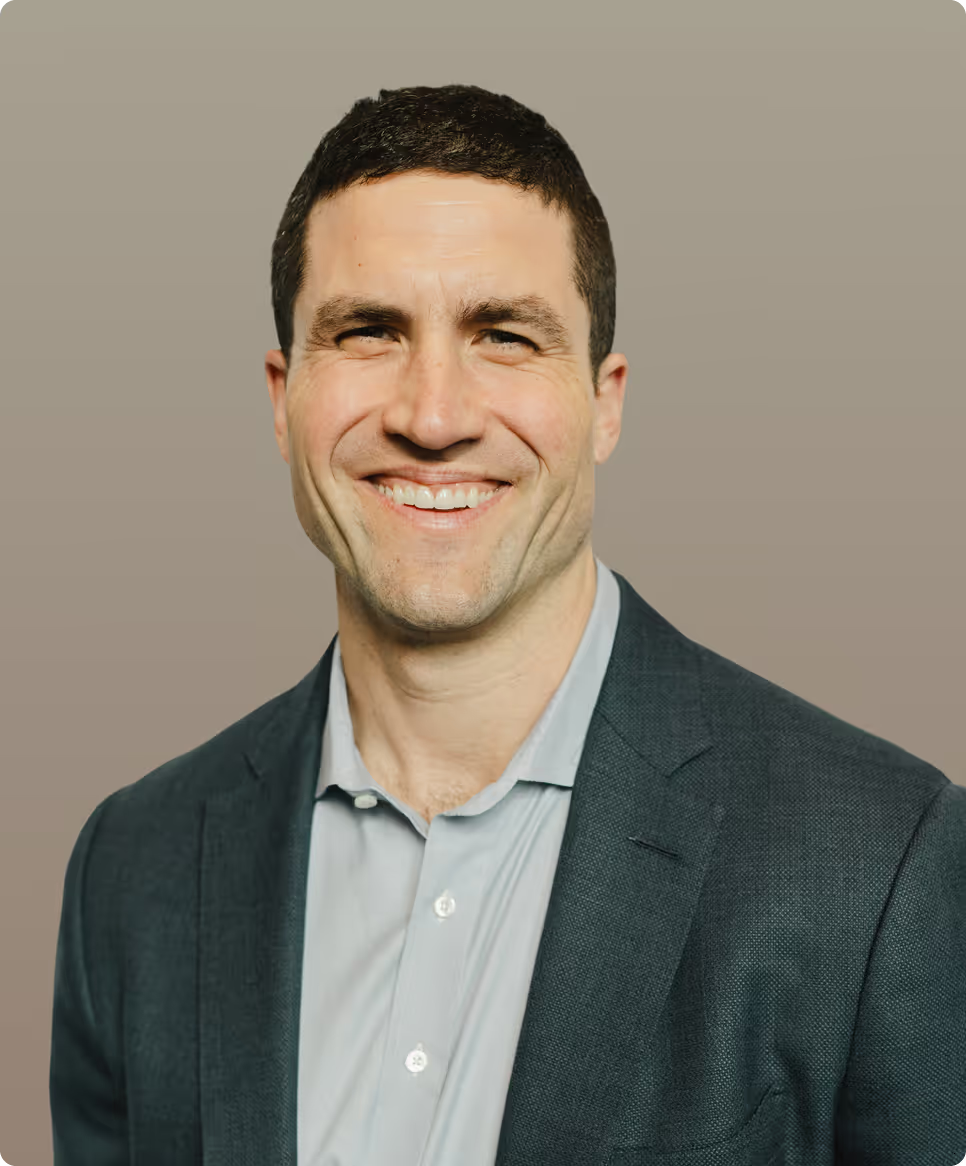
Alfred Johnson is co-founder and CEO of Crux, the capital platform for the clean economy. Before founding Crux, Alfred served as Deputy Chief of Staff to Secretary Janet Yellen at the US Department of the Treasury. Earlier in his career, Alfred was Vice President in Financial Markets Advisory at BlackRock, Senior Advisor for Financial Markets at the US Treasury, and Special Assistant to the White House Chief of Staff.
.svg)
.svg)
Share