As developers race to meet tax credit deadlines and lock in availability and pricing amid supply chain constraints, pre-notice-to-proceed (pre-NTP) equipment financing has become an essential part of the clean energy capital stack, enabling early procurement without tying up equity.
Debt-financed pre-NTP funding surpassed $7 billion in the first half of 2025, reflecting the trend that more developers are turning to broader development facilities and equipment-backed loans to keep projects moving. One component driving this momentum is developers’ push to safe harbor projects before tax credit phaseouts, coupled with the need to procure equipment that complies with forthcoming Foreign Entity of Concern (FEOC) restrictions.
As developers face these types of point-in-time capital needs, lenders are stepping in to finance upfront project costs while building long-term relationships that can extend to other financing stages. Development capital and equipment financing play a disproportionately important role in project development; despite representing a comparatively smaller fraction of total cost, access to capital at the pre-NTP stage is a key determinant of a project’s success.
This blog post breaks down the process to secure equipment financing, structures, and the factors lenders consider when making a deal.
Equipment financing is a type of asset-based lending used to fund the purchase of major project components (e.g., solar modules, transformers, wind turbines, batteries), often well before construction financing is available.
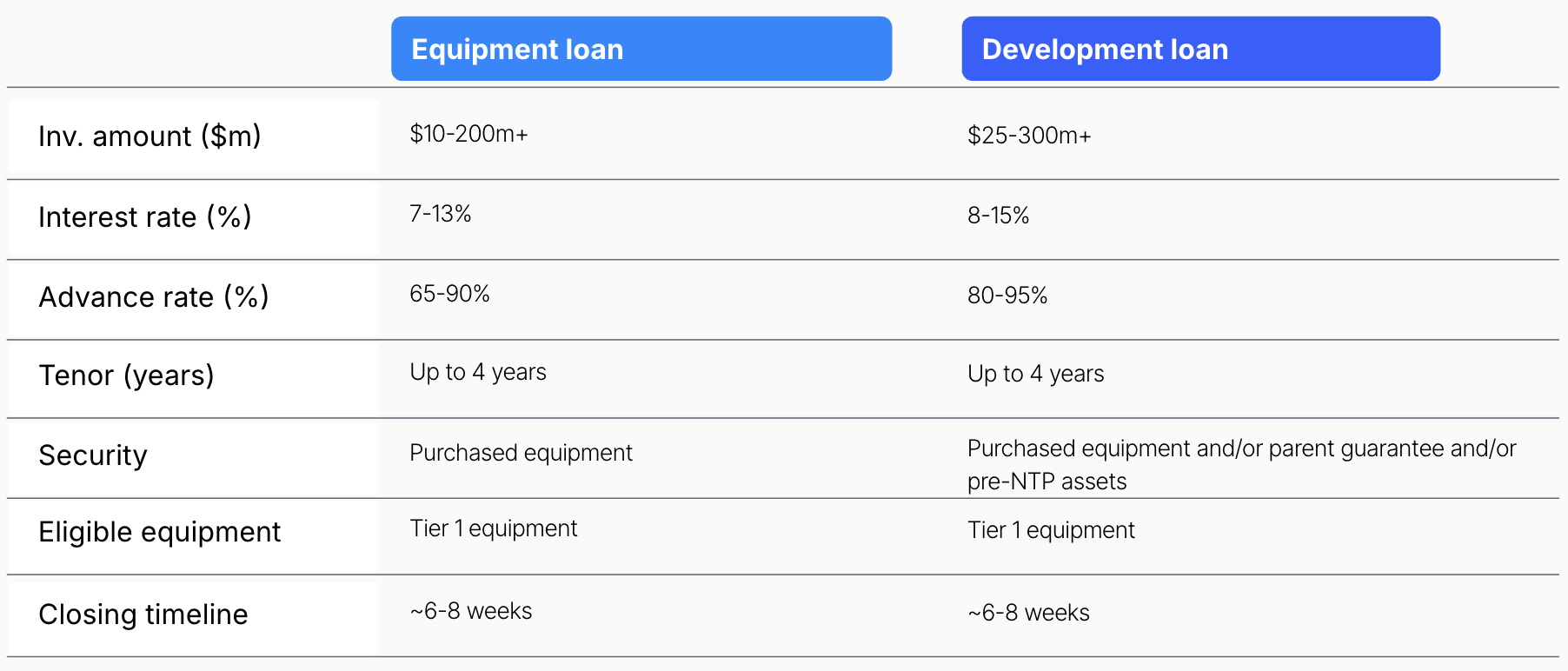
Used most commonly during the pre-NTP stage, these loans help developers make upfront equipment deposits, preserve tax credit eligibility, and cover other early development expenses. Compared to traditional development loans, standalone equipment financing is often more attractive to developers because it may offer a simpler collateral structure and can provide more efficient pricing relative to risk.
Comparison of typical features for equipment loans vs. development loans
Equipment financing also plays a strategic role in bridging the gap between initial development activities and full construction financing. It allows developers to efficiently secure equipment when supply chains are tight, demonstrate project maturity to future lenders and investors, and manage procurement risk.
At the same time, lenders benefit from financing assets with known value and strong resale potential, making these deals easier to evaluate and structure using standard asset-based lending models.
Equipment financing is expanding rapidly because it offers solutions to several challenges that clean energy developers face in the early stages of a project.
Procurement timelines have shifted earlier as developers face longer equipment lead times, stricter deposit requirements, and rising equipment costs. Equipment financing allows developers to place significant deposits — often 30–40% of total equipment costs — well before construction financing becomes available. This early capital helps developers lock in pricing while protecting against delays and missed delivery windows.
These pressures are only increasing as FEOC rules tighten eligibility and further constrain an already-limited pool of compliant suppliers. As demand concentrates on a smaller number of manufacturers, competition for key components is intensifying. Equipment financing helps developers stay ahead of these risks by giving them the flexibility to act quickly and secure equipment promptly.

Get our latest insights and favorite reads on the transferable tax credit market in your inbox.
Safe harbor provisions under the §48E investment tax credit (ITC) and §45Y production tax credit (PTC) allow projects to secure eligibility for higher tax credit values by demonstrating that construction is underway, provided the project is placed in service within four years.
Historically, the Internal Revenue Service (IRS) has recognized two methods for establishing that construction has begun on a qualified energy project:
However, under 2025 guidance from the US Department of the Treasury, the 5% cost test no longer applies to solar projects larger than 1.5 MW or any wind projects that begin construction on or after September 2, 2025. Those projects must utilize the physical work test to prove the beginning of construction.
As the 5% cost test phases out for these projects, equipment financing can play a key role in meeting the physical work test, especially when it supports the manufacturing of custom-made components.
Read Crux’s analysis of the Treasury’s guidance for more details on begin-construction and placed-in-service dates for wind and solar energy projects.
Equipment financings are inherently easier for lenders to underwrite compared to broad-use development facilities because they are backed by tangible, high-value assets with clear resale value. This gives lenders predictable collateral, faster diligence cycles, and lower overall risk compared to unsecured development loans.
As a result, many lenders are actively looking to deploy equipment financing capital. These transactions provide a lower-risk outlet for lenders to begin working with developers and build confidence in their execution capabilities, and they often serve as the first step toward deeper relationships that extend into construction financing and term debt.
Every equipment financing deal is unique. In some cases, a developer may have already obtained a portion of the equipment needed or could still be in the process of comparing vendors.
While the exact order of operations can vary, these transactions typically follow a similar pattern of core steps:
Developers select the equipment they plan to purchase and request vendor quotes. In some cases, the developer may have already signed a vendor agreement or made a deposit before engaging lenders.
At any point in the process, developers can begin conversations with lenders — either through existing relationships or by connecting with active capital providers — to assess financing options. Early outreach is ideal because it provides time to clarify lender requirements, assess deal feasibility, and align on potential terms based on the project’s status and equipment needs.
After conducting initial diligence on project and sponsor information, lenders issue a non-binding term sheet outlining proposed pricing, advance rates, and financing structure. This document reflects the lender’s initial interest and gives the developer a clear sense of deal economics. Developers should review the terms to confirm alignment and be prepared to share additional documentation, such as financial or legal information.
Depending on timing, the developer may sign a vendor agreement or purchase order before or after engaging a lender. In either case, the vendor agreement becomes a central underwriting document that confirms pricing, delivery timelines, and the collateral securing the loan.
Lenders evaluate project documentation, sponsor details, appraisals, and procurement information to validate and move the deal forward. Well-organized diligence materials help accelerate this step.
The loan is structured with the equipment serving as the primary collateral. The loan amount usually covers 65–95% of the equipment cost, depending on project specifics. Lenders consider factors such as equipment type, supplier tier, sponsor credit quality, and collateral structure when determining advance rates and final terms.
Equipment financing structures vary depending on what collateral is pledged and how much risk the sponsor takes on. Typically, the more security a developer provides, the more favorable the terms.
Most deals use one or more of the following credit support levers:
The loan is secured primarily — or, in some cases, solely — on the basis of the equipment. This can create a more contained form of credit support, with limited or no recourse to the sponsor. The lender’s underwriting focuses on the equipment’s value and essential role in the project.
A corporate or parent guarantee adds recourse to the developer or its ultimate sponsor, giving lenders more downside protection and improving pricing or advance rates for the developer. This structure provides stronger credit support, which can increase lender confidence, especially for newer developers with limited operating history.
In some cases, lenders expand the collateral beyond the equipment itself to include project-level assets or cash flows. This could involve a mix of pre-NTP, under-construction, or even partially contracted assets. These structures shift the deal closer to traditional project financing, where repayment is supported by the broader project rather than the equipment alone. With stronger collateral and reduced credit risk, lenders may offer lower interest rates or more favorable terms.
While equipment financing generally focuses more directly on the collateral and project pipeline compared to full-project financing, lenders still conduct diligence to ensure the credibility of all parties, terms, and projections.
Based on insights from Crux’s close relationships with 130+ lenders, the following are the core areas lenders evaluate most closely:
Lenders want confidence that a developer can execute and support the project through construction. Key elements include:
Because equipment serves as the primary collateral, lenders closely review:
Lenders want a complete view of where and when the equipment will be deployed within the context of the developer’s overall pipeline. They consider:
Equipment financing is secured by specific project components (e.g., solar panels or batteries) rather than the full project or future cash flows. It can offer lower interest rates than development loans and is available earlier than construction financing, helping developers cover major procurement deposits while conserving sponsor resources.
Lenders look for developers with a solid track record of successful projects, clear repayment strategies, and well-documented project pipelines. Strong credit support and credible equipment suppliers also boost lender confidence. The more organized and transparent the developer, the smoother the lender engagement and transaction process becomes.
Lenders typically review key documents, including equipment quotes or purchase agreements, sponsor financials, project pipeline details, and development budgets. To help developers accelerate underwriting and stay organized, Crux provides a dedicated diligence checklist tailored specifically for equipment financing.
Yes, many lenders can finance deals even if a deposit has already been placed, depending on timing and documentation. For example, some lenders may be willing to reimburse a developer for a previously made deposit if it was recent and supported by a signed purchase agreement and proof that the equipment hasn’t yet been delivered.
Some lenders build flexibility into their agreements, but significant delays may require updated construction start dates, placed-in-service expectations, or revised repayment strategies to ensure the loan remains aligned with the project’s risk profile and collateral value.
FEOC rules don’t directly impact financing eligibility, but they affect tax credit qualification, so lenders may require proof that equipment is sourced from compliant countries.
Pre-NTP equipment financing is playing an increasingly critical role in helping developers secure tax credits and funding, as well as moving projects toward construction. As market conditions shift and project timelines accelerate, having access to fast, flexible capital is more important than ever.
From an expert advisory team to purpose-built tools that streamline diligence and deal execution, Crux supports developers in raising capital efficiently and at favorable terms.
Looking to finance equipment ahead of upcoming deadlines? Find out how Crux can help you streamline and close capital raises.