
Major technology companies are turning to nuclear power to meet the massive electricity demands of AI computing and data center expansion. Amazon, Google, and Microsoft have all announced nuclear power purchase agreements in recent months, recognizing that nuclear power’s operational characteristics align well with data centers' need for reliable, 24/7 baseload power.
Despite nuclear power’s substantial contribution to the US electricity grid — about 19% of all power in the US and around half of all domestically produced zero-emission electricity comes from nuclear — existing nuclear power plants were not eligible for clean energy tax credits before the creation of the §45U zero-emission nuclear production tax credit in the Inflation Reduction Act (IRA) of 2022. Nuclear power also enjoys bipartisan support in Congress; the 2025 One Big Beautiful Bill (OBBB) preserved the §45U tax credit’s original 2032 phaseout date.
As data center electricity demand continues to climb and nuclear power seeks to meet this need, it is increasingly important for tax credit market participants to understand how the §45U tax credit is structured, how it has been transacting in the transferable tax credit market, and what tax credit investors should consider when evaluating these credits.
As an incentive to support existing nuclear power plants, the §45U production tax credit (PTC) provides a base credit of $0.003 per kilowatt-hour (kWh) of electricity produced and sold between December 31, 2023, and the end of 2032. Qualified facilities that meet prevailing wage and apprenticeship (PWA) adder requirements receive a credit multiplier of five times the base credit, raising the credit value to $0.015/kWh of electricity produced.
There is some additional nuance to how the actual PTC is calculated. The §45U credit is a contract for differences and phases out at higher power prices. The credit calculation changes based on a facility’s “gross receipts,” which includes revenues from the sale of electricity along with any state, local, or federal zero-emission credit programs or subsidies (other than the §45U credit).
If a facility’s gross receipts are at or below 0.025/kWh, the baseline credit is $0.003/kWh. If a facility generates gross receipts above $0.025/kWh, 16% of the gross receipts above that threshold is subtracted from the base credit value.
Put another way:
For example, say a facility brings in revenue from electricity sold at $0.030/kWh. To calculate the credit, the taxpayer must:
Importantly, facilities must utilize the net effective power price — inclusive of wholesale power, ancillary services, capacity payments, or other payments — to calculate their PTC entitlement based upon the receipts at the eligible facility.
PWA multipliers are incorporated after this calculation. In this example, the facility could claim up to $0.011/kWh assuming they meet PWA requirements ($0.0022 * 5 = $0.011).

Get our latest insights and favorite reads on the transferable tax credit market in your inbox.
Because the §45U tax credit is for existing nuclear facilities, only those facilities placed in service before August 16, 2022 can qualify.
Facilities must also sell power to a third party to generate the PTC. Realized market prices in these regions can impact the tax credit incentives that facilities receive. In 2024, for example, a large share of nuclear facilities in the PJM market generated §45U tax credits. Higher revenues for nuclear operators — especially due to PJM capacity price increases — reduced the amount of §45U credits available in the tax credit market due to the previously mentioned rules limiting tax credits to facilities that are below a defined revenue threshold.
Nuclear has quickly become one of the most active and highest-valued segments in the clean energy tax credit market. Although the Internal Revenue Service (IRS) has yet to publish final §45U guidance, the fact that these credits are generated by proven, baseload generation from facilities owned by investment-grade counterparties makes them attractive to tax credit buyers.
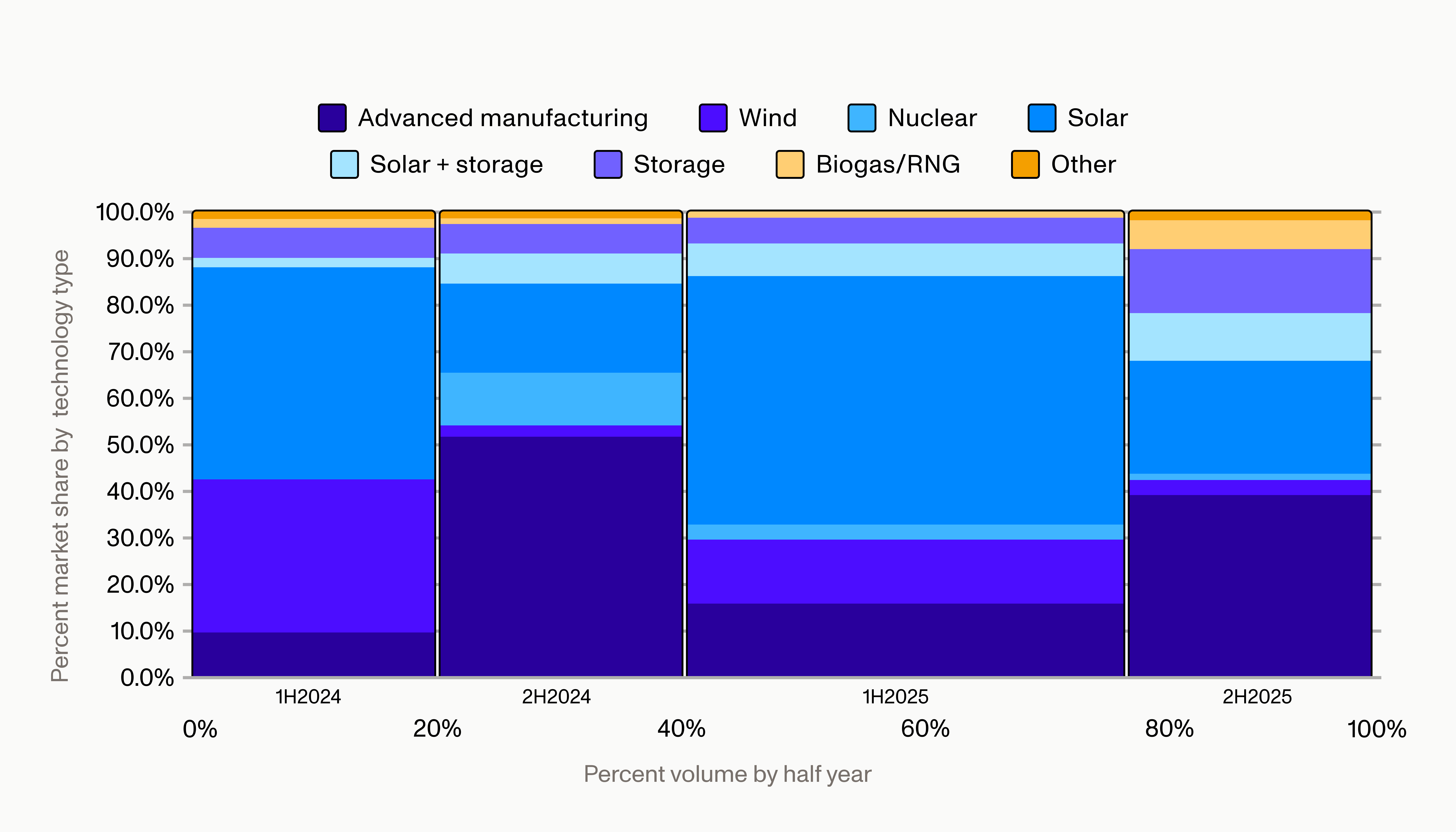
In the first quarter of 2025, §45U credits accounted for about 25% of all transferable tax credit transactions by deal count. In the first half of the year, §45U PTC transactions accounted for approximately 5–7% of the tax credit market by dollar value. Nuclear's market share declined in the second half of 2025, falling from 5.2% of total annual spot market volume in 1H2025 to 1.7% in 2H2025 — consistent with the broader reduction in buyer activity following passage of the One Big Beautiful Bill in July.
Total nuclear transaction volume for full-year 2025 is estimated at $200 million. Crux estimates that up to an additional $1 billion in eligible §45U credits did not transact during the year, with that volume expected to come to market in early 2026 as nuclear operators finalize production calculations and buyers return to the market with greater clarity on their 2025 tax positions.
Total market share by technology type, spot transactions 2024-2025
When §45U credits do transact, they command strong prices. 2025 pricing for nuclear credits was tightly clustered, averaging $0.962 with a range of $0.960–$0.970 — among the highest observed across all tax credit categories. Pricing exhibited limited dispersion across deal sizes and timing, consistent with nuclear credits being associated with operating assets, stable production profiles, and relatively low eligibility uncertainty.
In Crux's full-year 2025 dataset, insurance was not observed in any nuclear tax credit transactions. All observed deals involved investment-grade sellers who relied on parent guarantees, and buyers generally viewed these credits as low-risk without requiring additional structural protection.
Learn more: Download our nuclear market insights factsheet
New nuclear power plants that begin construction by 2034 are eligible for the technology-neutral §45Y PTC or §48E investment tax credit (ITC). Established under the IRA, the technology-neutral tax credits apply to zero-emissions facilities placed in service after December 31, 2024. Repowered nuclear facilities are also eligible for the §45Y or §48E credit if they meet the 80/20 repowering test; 80% of the project’s value must come from new equipment.
Driven by rising electricity demand and the availability of these incentives, a number of nuclear power plants are projected to enter service before the end of the decade. Planned facilities include small modular reactors (SMRs), fusion reactors, and several repowering projects.
Announced nuclear facilities
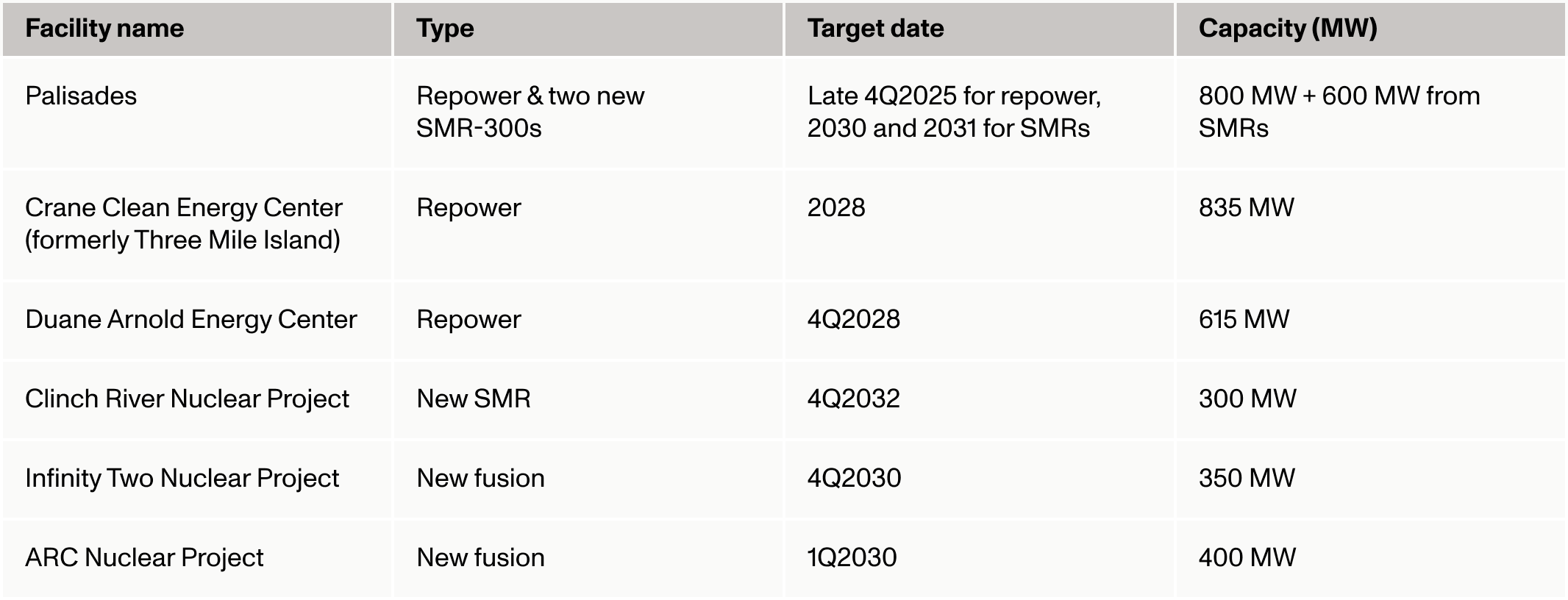
Because advanced and greenfield nuclear facilities take significant time to build, nuclear tech-neutral tax credit transactions for new facilities are not expected until the early 2030s. However, repowering projects will create new credits in the near term.
Crux has not yet observed any §48E or §45Y credits transactions, most likely because new nuclear power facilities remain in the development phase, but expects that repowering projects will begin to transact soon.
When these credits do begin to transact, we expect due diligence to focus on eligibility risks such as:
Crux expects demand for §45U nuclear tax credits to remain high thanks to investment-grade sellers and strong indemnities. Tax credit buyers that transact sooner rather than later stand to benefit from a wider credit selection and lower prices; Crux has observed that tax credit prices increase as available credit supply decreases.
As nuclear credits evolve from existing facilities into next-generation projects, tax credit buyers need partners who understand both the tax credit fundamentals and the technical complexities that make each transaction unique. That’s where Crux can help. Our team of transaction experts provides full-service support throughout the transaction, from curating a selection of vetted opportunities through diligence and deal close. We’re experienced in helping buyers navigate transactions with newly eligible technology types, providing the market intelligence and nuanced understanding needed to move confidently into emerging asset classes.
Interested in adding nuclear credits to your portfolio? Contact our team to learn how we can help you evaluate opportunities in this fast-growing market.