
All insights

Tax credit transaction risks: An introduction for corporate taxpayers

February 16, 2026

Transferable tax credits have significantly broadened access to clean energy finance. By allowing tax credits to be bought and sold for cash, rather than monetized solely through complex tax equity partnerships, transferable tax credits open the door to a broader range of corporate tax credit buyers and introduce greater liquidity and flexibility to project financing.

While transferable tax credit deals are less complex than tax equity partnerships, they do carry transaction risks. To ensure smooth transactions, corporate tax teams need a clear understanding of the diligence required to keep deals on track and the mechanisms available to protect their investments.

More than 70% of legal, tax, and financial advisors and insurers believe buyer education is the most important driver of a smooth tax credit transaction, reinforcing the need for internal preparedness. The more corporate tax teams understand the risk landscape, the faster they can close transactions.

This guide outlines the most common tax credit transaction risks buyers face and the practical steps used to mitigate them.

Why risk management is critical for tax credit buyers

In the early days of the transferable tax credit market, buyer diligence focused primarily on project eligibility and price. But as the market has matured and participation has broadened, corporate tax teams are applying more structured diligence to ensure transactions close smoothly and stand up over time.

Several trends are shaping how buyers approach tax credit transactions today:

  • Evolving federal guidance: Ongoing policy updates, especially those related to Foreign Entity of Concern (FEOC) compliance, are refining what buyers need to document and verify for certain credit types.
  • More participants, more potential: With more counterparties entering the market, buyers have access to a wider variety of project opportunities, each with its own documentation standards and timelines. 
  • Evolving internal expectations: As tax credit investments gain visibility, tax teams are increasingly positioned as strategic partners who are expected to bring speed and rigor to deal execution. 
  • Greater credit diversity: New credit types (e.g., §45X, §45Z) require buyers to evaluate different risk profiles and contract structures.

Leading corporate tax teams have responded to these trends by treating risk management as a core competency rather than a transactional hurdle. By standardizing their approach to diligence — across documentation, compliance review, and counterparty vetting — they’re able to move through internal approvals faster, reduce last-minute issues, and transact with greater confidence.

Read more: Benchmarking corporate taxpayer participation in tax credits

Top tax credit transaction risk factors — and how to mitigate them

While sellers are responsible for ensuring project compliance and documentation, buyers face financial risk if the credit is disallowed, recaptured, or adjusted. Without thorough diligence, buyers may overlook issues that later surface during an Internal Revenue Service (IRS) review or audit.

Fortunately, buyers have a range of tools, such as contractual indemnities and tax credit insurance, to help mitigate risk. And they don’t need to navigate this process alone. Legal counsel typically leads much of the diligence work, while partners such as Crux provide further support by underwriting and pricing risk more efficiently.

Below are the most common tax credit transaction risks and the strategies buyers use to manage them effectively. Keep in mind that the applicability of these risks can vary depending on credit type and whether a credit falls under the legacy or tech-neutral regime

Overview of risk types and applicability to credit types
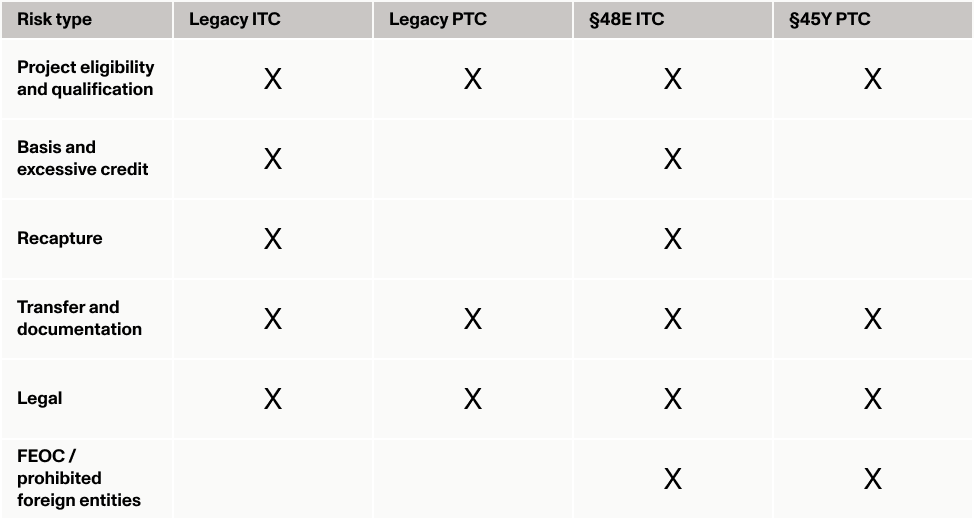
Table showing applicability of different transaction risks to legacy ITCs and PTCs as well as tech-neutral tax credits.

Project eligibility and qualification risk (ITCs and PTCs)

Tax credits are only valid if a project meets strict IRS requirements: 

  • Investment tax credits (ITCs): Projects must demonstrate qualification based on technology and eligible energy property, including any bonus credits (e.g., domestic content).
  • Production tax credits (PTCs): Projects must demonstrate qualification based on performance, verifying the actual production of eligible energy over time.

The IRS can disallow credits that do not meet these qualifications. Sellers typically provide representations and warranties to prove eligibility, but buyers often request independent verification of eligibility.

Common challenges include:

  • Evolving IRS guidance, including requirements to prove beginning-of-construction dates for wind and solar projects.
  • Lack of standardization in how developers document project qualification, especially regarding placed-in-service dates and eligibility status.
  • Inconsistent third-party reports (e.g., engineering certifications) that vary in scope and quality.

How buyers mitigate these risks:

  • Require independent review: Engage technical and legal advisors to review project qualification documents.
  • Verify core documentation: Ensure IRS registration numbers, placed-in-service certificates, and bonus adder documentation are accurate.
  • Use standardized checklists: Leverage platform-based diligence tools to ensure no criteria are overlooked. Crux has worked with leading law firms to develop transaction-specific diligence checklists that automatically populate diligence items directly from the transaction data room.
Screenshot of the Crux platform showing the diligence checklist
Crux's diligence verification suite leverages AI to auto-populate credit-specific diligence checklists

Basis and excessive credit transfer risk (ITCs)

ITCs must be valued properly. If the tax basis is overstated, the IRS may reduce the credit amount. This leads to excessive credit transfer risk, where the buyer has purchased more credits than the project actually earned.

Common challenges include:

  • Inconsistent basis calculation or valuation methods across developers.
  • Limited independent cost verification, especially on smaller or first-time projects.
  • Developer-reported cost summaries that lack full audit trails.

How buyers mitigate these risks:

  • Leverage insurance: Tax credit insurance policies frequently cover basis risk, protecting the buyer if the IRS challenges the valuation.
  • Review engineering, procurement, and construction (EPC) contracts: Work with advisors to confirm that construction costs align with market norms.
  • Analyze third-party reports: Review cost segregation reports and appraisals (a practice followed by more than 80% of advisors, according to Crux’s risk mitigation report). 

Recapture risk (ITCs)

If an ITC-generating project is sold or destroyed without being rebuilt within five years of being placed in service, the IRS can "recapture" a portion of the credit. However, this is statistically very rare. Crux research shows that recapture has occurred in just 0.5% of deals. It's also worth noting that, under the ITC recapture schedule, the amount subject to recapture declines by 20% for each full year the project remains in service, fully phasing out after five years.

Common challenges include:

  • Limited buyer visibility into how the project is operated post-closing.
  • Unclear allocation of liability between buyers, sellers, and operators.

How buyers mitigate these risks:

  • Negotiate strong indemnities: The transfer agreement should outline responsibility for recapture events. Crux's tax credit transfer agreement (TCTA) forms include market-standard language to help buyers align on these terms.
  • Purchase insurance: This is especially important for higher-risk projects (e.g., assets in regions prone to severe weather).
  • Set reporting requirements: Establish post-closing reporting for material events or changes in ownership.

Transfer and documentation risk (all credit types)

Even when a project is fully qualified, the buyer can still lose the benefit of the credit if the seller doesn’t execute the transfer in full compliance with IRS requirements. 

Common challenges include:

  • Evolving IRS registration portal requirements, including updates to required data fields and validation checks.
  • Version control issues during document exchange, especially when multiple firms are revising agreements and diligence materials.

How buyers mitigate these risks:

  • Maintain a complete document set: Ensure you possess registration certificates, transfer agreements, and all supporting eligibility materials.
  • Centralize document management: Use a single platform to prevent version conflicts and ensure that all parties rely on a single source of truth.

Legal risk (all credit types)

The validity of a tax credit transfer depends on the seller’s clear ownership of the underlying energy property and their legal ability to transfer the credit. Ownership disputes or hidden liens can impact the validity of a credit transfer.

Common challenges include:

  • Complex or poorly documented ownership chains, especially where projects have changed hands multiple times.
  • Liens on project assets or credit proceeds that require lender consent.

How buyers mitigate these risks:

  • Obtain consents: Get lender consents or lien releases as necessary to ensure the seller has the authority to transfer the credit.
  • Create an audit trail: Maintain clear records of ownership and transfer, including organizational charts, assignment agreements, and Uniform Commercial Code (UCC) searches to verify clear title.

FEOC compliance risk (tech-neutral credits, §45X PTCs) 

The One Big Beautiful Bill (OBBBA), passed in July 2025, introduced FEOC requirements that apply to tech-neutral credits (§48E and §45Y). Projects claiming these active credits are subject to three key FEOC requirements:

  • Entity restrictions, as developers that are specified foreign entities cannot claim credits for tax years beginning after July 4, 2025.
  • Contracts with specified foreign entities cannot grant them control over facility operations or production.
  • Projects beginning construction after 2025 must observe limits on materials sourced from prohibited foreign entities (PFEs).

Common challenges include:

  • Keeping up with evolving guidance, including how to demonstrate compliance with material assistance cost ratio requirements.
  • Difficulty tracing and verifying supply chains to ensure PFE restrictions are met.

How buyers mitigate these risks:

  • Contractual covenants: Include covenants in the transfer agreement restricting payments to specified foreign entities that could trigger violations.
  • Comprehensive diligence: Work with advisors to assess FEOC risk and stay current on guidance. Crux provides a regularly updated, FEOC-specific due diligence checklist covering specified foreign entity and prohibited foreign entity reviews for most credit types, as well as effective control and material assistance reviews for tech-neutral and §45X credits. 

Confidence through diligence: How leading buyer teams de-risk transactions

Understanding risk is only part of the equation. The most successful buyers also manage diligence efficiently by working closely with legal counsel and specialized advisors, using proven frameworks to guide each transaction. That way buyer teams can stay informed and assist in setting strategy and end goals without getting bogged down in every detail. 

Top-performing teams consistently:

Systematize processes 

Rather than reinventing the wheel for every transaction, leading buyers utilize standardized workflows that help internal teams align quickly. For example, using market standard transfer agreements (like those available on Crux) helps parties align on risk mitigation terms without protracted negotiations.

Require strong indemnification and insurance

Top-performing buyers proactively negotiate indemnities that clearly allocate responsibility for recapture, basis disputes, or disallowed credits. In turn, tax credit insurance has become a staple of the market. It enables buyers to transfer over specific risks and move quickly on promising opportunities.

Read more: A Guide to the Tax Credit Insurance Market

Engage early

The most successful teams begin diligence early. Early alignment between buyer and seller regarding documentation quality, prevailing wage and apprenticeship (PWA) compliance, and cost substantiation creates shared expectations and minimizes review cycles.

Use independent verification

Buyers are not expected to be engineers. Confidence in the transferable credit market requires traceability, but the heavy lifting of technical verification can be delegated to specialized advisors.

How Crux strengthens buyer confidence

With full-service, end-to-end transaction guidance,  Crux helps buyers move from diligence to closing with ease. 

Buyers on Crux benefit from a curated selection of pre-vetted credits from top-tier developers and manufacturers, along with expert guidance from a team that brings vast experience across finance, tax, and project development. We work closely with leading legal and insurance partners to help ensure that every transaction is properly structured and de-risked.

Using deep market knowledge paired with standardized documentation, industry-specific diligence workflows, and data-backed insights drawn from more than $55 billion in credit transactions, Crux equips buyers and their advisors with the tools to assess and close deals efficiently and with minimal risk.

Learn more about how Crux can support your approach to the tax credit market.

Ready to join Crux?

Get started